

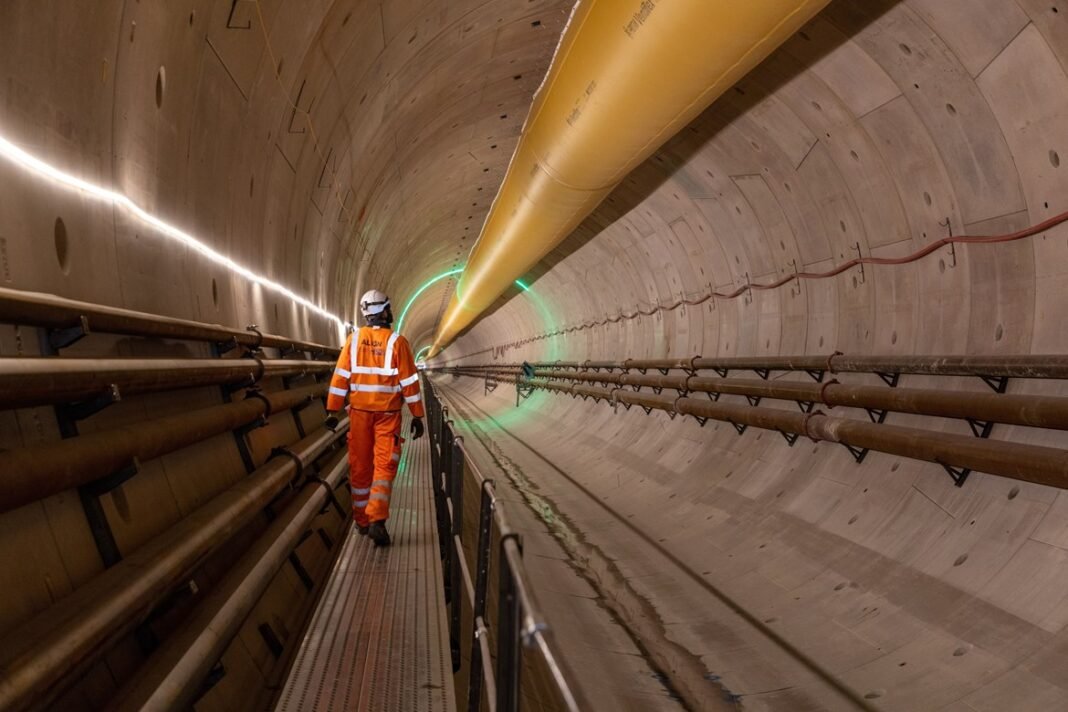
In a significant engineering milestone that signals both achievement and ambition, construction has been completed on the Chiltern Tunnel, the longest tunnel in Britain’s High Speed 2 railway project.
The completion of this 10-mile underground passage beneath the Chiltern Hills marks more than just another box ticked on a controversial mega-project.
It represents a statement about Britain’s capability to deliver world-class infrastructure despite formidable challenges, and offers crucial lessons for the nation’s infrastructure future.
An Engineering Marvel Below the Chalk Hills
Stretching approximately 16 kilometers beneath the Chiltern Hills between Hertfordshire and Buckinghamshire, the twin-bore Chiltern Tunnel stands as a testament to modern tunneling prowess.
The scale of the achievement is staggering: two 2,000-tonne tunnel boring machines excavated three million tonnes of chalk during their 33-month journey.
The tunnel boring machines, christened Florence and Cecilia after nursing pioneer Florence Nightingale and astrophysicist Cecilia Payne-Gaposchkin, operated as underground factories.
Each machine was a self-contained operation, digging the tunnel, lining it with concrete wall segments and grouting them into place as it moved forward.
The machines advanced at a steady pace of around 16 meters per day, with crews of 17 working in 12-hour shifts supported by over 100 people on the surface.
The breakthrough came in early 2024 when both machines completed their drives, Florence in February and Cecilia in March. But the tunneling was only the first chapter.
Since then, engineers have been constructing 38 cross passages linking the twin tunnels, five deep ventilation shafts reaching depths of up to 78 meters, and installing emergency walkways and safety systems.
Solving the Sonic Boom Challenge
Perhaps the most innovative aspect of the Chiltern Tunnel is its solution to a problem that has plagued high-speed rail since the 1970s: the sonic boom effect.
When high-speed trains enter tunnels, they compress air ahead of them, creating pressure waves that emerge as loud thuds or booms at tunnel exits.
Engineers developed specialized portal extensions at both ends of the tunnel, with the southern extensions completed in January 2025.
These structures, extending up to 220 meters from each tunnel entrance, are perforated with ventilation openings that allow compressed air to escape gradually, preventing the pressure buildup that causes sonic booms.
The approach is uniquely British. While Japan solved similar problems by giving their Shinkansen trains elongated aerodynamic noses, HS2 engineers opted to modify the tunnel infrastructure instead, allowing conventional train designs to operate at speeds of up to 200 mph.
When operational, trains will traverse the 10-mile tunnel in just three minutes.
Sustainability as Standard
The environmental approach to the Chiltern Tunnel project offers a blueprint for sustainable mega-infrastructure.
Rather than trucking away the three million tonnes of excavated chalk, project teams repurposed the material on-site to create more than 120 hectares of chalk grassland around the southern portal.
This single project has expanded Buckinghamshire’s biologically diverse grassland habitat by nearly a fifth, creating internationally significant conservation areas where only 700 hectares previously existed across the entire Chilterns.
The ventilation shaft headhouses, designed by Grimshaw architects, were deliberately crafted to blend with the landscape.
Some have been intentionally disguised as agricultural buildings to minimize visual impact on the Chilterns Area of Outstanding Natural Beauty.
What This Means for Britain’s Infrastructure Future
The Chiltern Tunnel’s completion arrives at a pivotal moment for British infrastructure. The project demonstrates that Britain still possesses the technical capability and expertise to deliver complex engineering on a grand scale.
However, it also illuminates the challenges that have plagued HS2 and threaten future mega-projects.
The wider HS2 project has been plagued by cost overruns and delays. Originally planned to open by 2026, the timeline has slipped repeatedly, with the current target now unachievable.
Cost estimates for the London-Birmingham line alone have ballooned to up to £66 billion. The northern extensions to Manchester and Leeds have been scrapped entirely, fundamentally changing the project’s scope and benefits.
Yet the Chiltern Tunnel itself was delivered ahead of schedule, suggesting that when design, planning, and execution align properly, British construction can excel.
The tunnel’s success offers several critical lessons for future infrastructure endeavors.
Lessons for the Next Generation of Mega-Projects
Design Before You Dig: One of HS2’s core failures, as identified by Chief Executive Mark Wild in his assessment to the Transport Secretary, was that construction started too soon, before stable and consented designs were available.
The Chiltern Tunnel, by contrast, benefited from thorough design work and planning that began in 2017, with construction commencing only after preparatory work was complete.
Innovation in Execution: The bespoke tunnel boring machines, purpose-built factory for producing 112,000 concrete lining segments on-site, and innovative sonic boom mitigation demonstrate that British engineering can still push boundaries when properly resourced and planned.
Environmental Integration: The creation of significant new wildlife habitats from excavated material and the careful architectural integration with protected landscapes show that mega-infrastructure doesn’t have to be environmentally destructive.
Collaboration at Scale: The Align Joint Venture, bringing together Bouygues Travaux Publics, Sir Robert McAlpine, and Volker Fitzpatrick, along with consultancy support from Arup and academic partnerships, demonstrates the value of integrated project delivery.
The Broader Infrastructure Landscape
Britain is embarking on an unprecedented wave of mega-infrastructure projects.
Beyond HS2, the portfolio includes the £9 billion Lower Thames Crossing with its record-breaking road tunnels, the multi-billion-pound Transpennine Route Upgrade, East West Rail connecting Oxford and Cambridge, and the ambitious Sizewell C nuclear power station.
Each faces similar challenges: cost control, delivery timelines, planning approvals, and public support.
The £5 billion Thames Tideway Tunnel, which became operational in 2025, offers another success story, showing that complex underground infrastructure can be delivered when properly planned.
The Eastern Green Link projects, creating high-voltage electricity transmission superhighways, and various metro systems across British cities demonstrate that infrastructure ambition remains strong.
However, the pattern of delays, budget overruns, and scaled-back ambitions that has characterized recent decades threatens to undermine this potential.
A Crossroads for National Ambition
The Chiltern Tunnel stands as both an achievement and a warning. It proves Britain can still build world-class infrastructure that solves complex technical problems while respecting environmental constraints.
The engineering excellence on display, from the precision tunneling to the innovative sonic boom mitigation, sets new international benchmarks.
Yet this single tunnel, remarkable as it is, forms only part of a railway that has become synonymous with spiraling costs and diminished scope.
The original vision of a transformational high-speed network connecting London, Birmingham, Manchester, and Leeds has been reduced to a London-Birmingham line with an uncertain completion date and a price tag that has shocked the nation.
For Britain’s infrastructure future, the question is whether the lessons of what worked in the Chiltern Tunnel—thorough design, technical innovation, environmental integration, and collaborative delivery—can be applied more broadly.
Or will the wider failures of project management, cost control, and political will continue to undermine national infrastructure ambitions?
The Path Forward
As the Chiltern Tunnel prepares for the installation of track, overhead electrification, and railway systems, it represents more than buried concrete and chalk.
It embodies the tension between Britain’s undeniable engineering capability and its struggling infrastructure delivery system.
The completion of this engineering feat should inspire confidence that when Britain commits to infrastructure with proper planning, design, and execution, extraordinary things remain possible.
The challenge now is to apply these lessons systematically across the pipeline of projects needed to modernize the nation’s transport, energy, and utilities infrastructure.
The Chiltern Tunnel will stand for generations as a monument to what British engineering can achieve.
Whether it becomes a beacon for a new era of successful infrastructure delivery or a reminder of squandered potential depends on the choices made in boardrooms, government offices, and construction sites across the country in the years ahead.
For now, beneath the rolling Chiltern Hills, two tunnels wait silently for the high-speed trains that will one day thunder through at 200 mph, covering in three minutes a distance that took three years to excavate.
That juxtaposition of patience and speed, of monumental effort for brief transit, captures something essential about infrastructure itself: the long, difficult work of building the future, one tunnel, one project, one decision at a time.
Also Read
World’s Tallest Building Nears Completion
Africa Construction in Rail and Ports: Boosting Regional Trade

- From Operator to Algorithm: Bedrock Puts Autonomous Excavators to Work on Live Construction Sites - September 7, 2026
- Built For The Rough Stuff: Inside Titan’s new ForestEDGE™ Tyre Line - September 4, 2026
- South Africa Has R395 Billion in Infrastructure Projects — But Can the Industry Deliver Them? - August 26, 2026
