

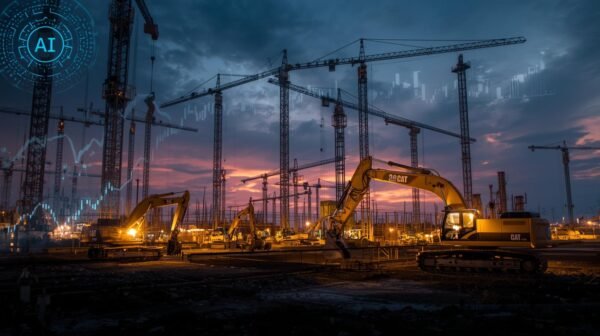
January 15, 2026 – While most construction professionals think of Caterpillar as the yellow bulldozer company, a massive transformation is underway.
The century-old equipment giant is quietly becoming the backbone of America’s artificial intelligence infrastructure boom, and the numbers tell a stunning story.
From Bulldozers to Data Centers: A Historic Shift
For the first time in Caterpillar’s 100-year history, its Energy and Transportation division has overtaken the traditional construction equipment business.
In 2024, energy and transportation revenues hit $28.9 billion compared to $25.5 billion for construction industries. This wasn’t a slow evolution but a rapid acceleration driven by one factor: AI’s insatiable appetite for power.
The transformation became undeniable in the third quarter of 2025, when Caterpillar’s Energy and Transportation division reported a stunning 17-year-over-year revenue jump, driven almost entirely by data center power generation projects.
The division now carries a record-breaking $40 billion backlog, with data center projects accounting for a significant portion of future work.
The Power Problem Construction Can’t Ignore
Here’s the reality facing the construction industry: modern AI data centers don’t just need more power than traditional facilities.
They need exponentially more. A single large AI data center can consume as much electricity as 100,000 homes. Some of the newest hyperscale campuses being planned will require multiple gigawatts of power, equivalent to the output of several conventional power plants.
The challenge goes beyond raw capacity. These facilities need power immediately, reliably, and often in locations where the local electrical grid simply cannot deliver.
Traditional utility connections can take years to establish and may never reach the capacity required. This creates an unprecedented opportunity for on-site power generation, and Caterpillar has positioned itself perfectly to capitalize.
Gigawatt-Scale Projects Reshape Construction Landscape
In August 2025, Caterpillar announced a partnership with Joule Capital Partners to power a massive data center campus in central Utah.
The scale is almost difficult to comprehend: four gigawatts of total energy capacity across 4,000 acres, with initial computing capacity launching in 2026.
The project will deploy a fleet of Caterpillar’s latest generation turbines and generator sets, integrated with 1.1 gigawatt-hours of battery energy storage.
The system doesn’t just provide electricity but captures waste heat to power and cool the high-density server systems, maximizing efficiency in ways traditional construction projects rarely consider.
What makes this particularly significant for construction professionals is the speed advantage.
Thanks to Caterpillar’s expanding domestic manufacturing footprint, these integrated power systems can be delivered faster than traditional generation technologies.
In an industry where time-to-power determines competitive advantage, this capability is proving invaluable.
Following the Money: A New Construction Ecosystem
The data center power boom is creating ripple effects across the entire construction supply chain. Caterpillar signed another major partnership with Hunt Energy Company in late August 2025, targeting delivery of up to one gigawatt of power generation capacity for data centers across North America.
The first project launched in Texas, marking the beginning of a multi-year initiative with potential for global expansion.
In November 2025, Caterpillar and Vertiv announced a strategic collaboration to integrate power generation with cooling and distribution systems.
This partnership recognizes that modern data center construction requires end-to-end energy solutions, not just individual components.
The collaboration delivers pre-designed architectures that accelerate deployment timelines, a critical factor when hyperscale operators are racing to bring capacity online.
Construction professionals should note the shift in project economics. Current data center construction averages range from $7 million to $12 million per megawatt of capacity, with some hyperscale campuses exceeding $20 billion in total investment.
Many individual projects fall between $500 million and $2 billion, dwarfing traditional commercial construction budgets.
What This Means for Construction Contractors
The implications extend far beyond Caterpillar’s balance sheet. The data center construction surge is creating unprecedented demand for specialized trades and driving wage premiums across the board.
Construction salaries in the data center sector are rising 12 to 18 percent, with project managers averaging $165,000 and AI infrastructure specialists reaching $200,000 annually.
Electricians with data center experience command significant premiums because the work requires advanced technical skills in high-density power distribution, sophisticated cooling systems, and complex commissioning processes.
Employment projections suggest data center construction and operations could reach 650,000 positions across the United States, with 2026 representing the peak year for hiring growth.
The skilled trades in highest demand include MEP engineers, commissioning agents, electrical specialists, and controls technicians who can handle the unique requirements of AI-optimized facilities.
Critical equipment lead times have stretched to 14 months for essential components like switchgear and generators.
This is creating a power-first strategy where electrical contractors and specialized trades are being hired earlier in project lifecycles than ever before. Some operators are even pre-purchasing equipment before final site selection to ensure manufacturing queue positions.
Regional Hotspots and Market Dynamics
While Northern Virginia has long dominated data center construction, the AI boom is spreading opportunities nationwide.
Major growth markets include Ohio, Texas, Arizona, Iowa, and emerging regions across the Southeast. The expansion is driven partly by grid capacity constraints in traditional markets and partly by the massive scale of new projects requiring substantial land and power infrastructure.
Contractors report that 65 percent expect the data center market to expand in 2026, with only 8 percent anticipating contraction.
This optimism stands in stark contrast to broader commercial construction sentiment, where economic uncertainty and compressed margins are creating cautious outlooks.
However, industry veterans warn against over-reliance on a single hot sector. The data center boom offers larger budgets, faster timelines, and strong investor support, but contractors must maintain diversified project portfolios across institutional work, infrastructure, and other sectors to protect against potential market corrections.
The Bigger Picture: Power Infrastructure Revolution
Caterpillar’s transformation from construction equipment manufacturer to AI infrastructure provider reflects a broader trend that construction professionals cannot ignore.
The company expects its power and energy business to help lift annual sales growth to 5 to 7 percent through 2030, compared to about 4 percent in recent years.
Management is backing this projection with a $725 million expansion at its Lafayette, Indiana plant to more than double turbine production capacity.
The stock market has taken notice. Caterpillar shares surged approximately 61 percent in 2025, more than tripling the S&P 500’s gain, as investors recognized the company’s positioning in the AI infrastructure value chain.
The stock trades near all-time highs with a market capitalization approaching $200 billion.
For construction firms, the lesson is clear: the AI revolution is not just a technology story but a massive infrastructure build-out that will define construction opportunities for the next decade.
The companies and contractors who understand the unique power, cooling, and speed requirements of AI data centers will be positioned to capture premium margins in a market that shows little sign of slowing.
The data center construction boom that many dismissed as temporary is instead accelerating into 2026 and beyond.
Electricity demand from data centers is projected to more than double by 2030, potentially reaching 945 terawatt-hours annually. This growth is driving grid modernization projects, utility-scale upgrades, and entirely new approaches to power generation and distribution.
The Bottom Line for Construction Professionals
Caterpillar’s $40 billion backlog and strategic pivot to power generation represents more than one company’s success story. It signals a fundamental shift in how America builds the infrastructure to support artificial intelligence and advanced computing.
For contractors, electrical specialists, MEP engineers, and construction firms across the country, this transformation presents both opportunity and challenge.
The projects are larger, the timelines compressed, the technical requirements more demanding, and the compensation more attractive than traditional commercial work.
But success requires adaptation, specialized knowledge, and willingness to operate at the intersection of construction and cutting-edge technology.
As the industry enters what may prove to be the largest infrastructure construction wave since the interstate highway system, those who recognize power generation as the new foundation of modern construction will be best positioned to thrive.
The yellow bulldozers aren’t going anywhere, but increasingly, it’s the power generators that are driving Caterpillar’s growth and shaping the future of American construction.
Stock performance data current as of January 15, 2026. Project details based on publicly announced partnerships and construction timelines subject to change.
Also Read
US stock futures: Construction Stocks Navigate Mixed Signals as Markets Push Higher
What United Rentals’ Upgrade Really Tells Us About 2026 Infrastructure Spending

- PV Guangzhou 2027 to Highlight Solar and Energy Storage Technologies - October 22, 2026
- Accurate and Reliable Measurement and Monitoring of Industrial Plant Water Treatment - October 21, 2026
- SODECA Highlights Industrial Ventilation Technology at Mega Clima Expo Kenya 2026 - October 14, 2026