

The construction industry loses approximately $177 billion annually to rework and delays, according to industry research.
As projects grow more complex and stakeholder expectations rise, traditional monitoring methods are proving inadequate.
Today’s construction sites are embracing innovative technologies that transform how teams track progress, identify issues, and maintain quality—fundamentally changing an industry long resistant to digital transformation.
The Hidden Cost of Poor Construction Monitoring
Construction projects face persistent challenges that drain budgets and extend timelines. The average large construction project runs 20 months behind schedule and exceeds its budget by 80%, creating a compelling case for better monitoring solutions.
Common monitoring failures include:
- Delayed detection of quality issues requiring expensive rework
- Incomplete documentation leading to disputes and liability claims
- Poor coordination between multiple trades causing schedule conflicts
- Inaccurate progress tracking resulting in cash flow problems
- Safety incidents from unidentified hazards
These challenges compound throughout a project’s lifecycle. A structural issue undetected during foundation work might only surface during framing, requiring demolition and reconstruction at exponentially higher costs.
Digital Transformation: Core Technologies Reshaping Construction Monitoring
Reality Capture and 3D Scanning
Laser scanning and photogrammetry have revolutionized how teams document construction progress. These technologies create precise digital twins of physical spaces, enabling comparisons between as-built conditions and design intent.
Key applications include:
Modern laser scanners capture millions of data points per second, creating detailed 3D models with millimeter accuracy.
Contractors use these scans to verify MEP installations, confirm dimensional accuracy, and document existing conditions before renovation work. The technology particularly excels in complex spaces where manual measurements would be time-prohibitive.
Photogrammetry, which reconstructs 3D models from photographs, offers a more accessible entry point. Using drones or smartphones, teams capture overlapping images that software processes into accurate models.
This approach democratizes reality capture, allowing smaller contractors to benefit from digital documentation without significant capital investment.
Drones: Eyes in the Sky
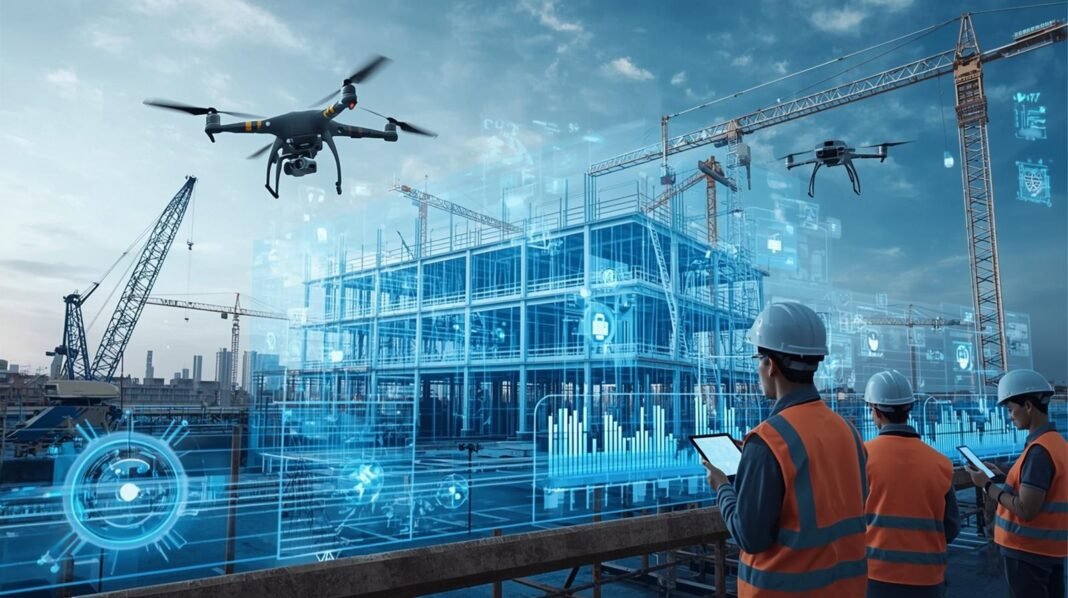
Unmanned aerial vehicles have become ubiquitous on construction sites, offering perspectives impossible from ground level. Weekly or daily drone flights create comprehensive progress records, capturing site conditions across large areas in minutes.
Drones excel at:
Monitoring earthwork and grading progress across expansive sites, providing volumetric calculations that inform payment applications and schedule tracking.
Inspection of high or difficult-to-access areas including roofs, facades, and structural steel connections. Capturing marketing and stakeholder update materials that demonstrate progress to investors and community members.
Advanced drones integrate thermal imaging cameras that identify moisture intrusion, insulation gaps, and electrical hotspots—issues invisible to standard photography.
This capability transforms quality control, catching problems before they compromise building performance.
Computer Vision and AI
Artificial intelligence is teaching cameras to understand construction sites. Computer vision algorithms analyze photos and videos to automatically detect safety violations, track worker productivity, and verify installation quality.
AI-powered monitoring systems can:
Identify incomplete or defective work by comparing site photos against BIM models and specifications, flagging discrepancies for immediate correction.
Track PPE compliance by recognizing workers without hard hats, safety vests, or other required equipment.
Monitor material deliveries and stockpile levels, alerting teams when inventory drops below thresholds. Analyze productivity by measuring work output against planned schedules, identifying bottlenecks before they cascade into delays.
Machine learning improves these systems over time. As algorithms process more project data, they better distinguish between acceptable variations and genuine problems, reducing false alerts while catching subtle issues human observers might miss.
Building Information Modeling (BIM) Integration
BIM has evolved from a design tool into a central platform for construction monitoring. Modern workflows integrate real-time site data directly into BIM models, creating living documents that reflect actual conditions.
4D and 5D BIM connect three-dimensional models with schedule and cost data. As work progresses, teams update model elements with completion dates and actual costs. This integration enables powerful analyses, revealing whether projects are ahead or behind schedule, where budgets face pressure, and which activities drive critical path impacts.
Cloud-based common data environments serve as single sources of truth, ensuring all stakeholders access current information.
When a subcontractor updates a BIM element to reflect completed work, that change immediately flows to schedulers, estimators, and quality managers—eliminating the information lag that plagued paper-based workflows.
Clash detection runs continuously, comparing as-built conditions captured through reality capture against design models.
This automated comparison identifies conflicts between trades, dimensional errors, and deviations from specifications, triggering immediate corrective action rather than discovering problems during final inspections.
Internet of Things (IoT) and Sensor Networks
Embedded sensors transform construction sites into data-rich environments, providing real-time insights into conditions and performance.
Environmental sensors monitor temperature, humidity, and concrete curing conditions, ensuring materials achieve specified strengths and preventing weather-related quality issues. Alerts notify teams when conditions fall outside acceptable ranges, enabling interventions that protect work quality.
Structural monitoring systems use strain gauges, tilt sensors, and vibration monitors to track building behavior during construction. These systems prove particularly valuable during concrete pours, excavations adjacent to existing structures, and tower crane operations where structural loads approach design limits.
Equipment telematics track machinery location, utilization, and maintenance needs. Fleet managers optimize equipment deployment, ensuring machines are positioned where needed while identifying underutilized assets that could be redeployed or returned to rental yards.
Wearable technology including smart helmets and safety vests monitor worker location, detect falls, and measure environmental exposure. Beyond safety benefits, location data helps analyze workflow efficiency, revealing congestion points and coordination problems.
Mobile Technology and Field Connectivity
Smartphones and tablets have become essential construction tools, extending office capabilities to the field. Mobile apps enable real-time data capture, reducing the lag between observation and documentation that allowed problems to escalate.
Field teams use mobile platforms to:
Complete digital punch lists with embedded photos and precise location data, creating clear work orders that eliminate ambiguity.
Submit and approve RFIs without returning to trailers, accelerating decision cycles that previously consumed days.
Access current drawings and specifications from anywhere on site, ensuring work proceeds from the latest information. Log daily reports, safety observations, and quality checks in standardized formats that populate project dashboards automatically.
Offline capabilities ensure connectivity interruptions don’t halt productivity. Apps sync data when connections resume, maintaining workflow continuity despite spotty cellular coverage common on construction sites.
Advanced Analytics and Predictive Insights
Construction monitoring generates vast data streams. Advanced analytics transform this information into actionable intelligence, enabling proactive management rather than reactive firefighting.
Predictive analytics apply machine learning to historical and current project data, forecasting likely outcomes.
These models identify activities at high risk of delay, estimate completion dates with confidence intervals, and project final costs based on current trends. Armed with predictions, teams intervene early, adjusting resources or methods before problems crystallize into crises.
Benchmarking dashboards compare current performance against historical norms and peer projects, revealing whether productivity, safety, and quality metrics meet expectations. When metrics lag, teams investigate root causes and implement corrective actions.
Automated reporting assembles data from multiple sources into stakeholder-specific dashboards and reports.
Executives see high-level summaries highlighting risk areas, while field supervisors access detailed activity data supporting daily decision-making. This automated approach eliminates the hours project managers traditionally spent compiling status reports, redirecting that effort toward value-adding activities.
Digital Twins: The Integration of All Monitoring Data
Digital twins represent the convergence of construction monitoring technologies. These virtual replicas combine BIM geometry with real-time sensor data, creating comprehensive simulations of physical assets.
Construction-phase digital twins ingest data from:
Reality capture systems that update models with as-built geometry, ensuring the twin accurately reflects physical conditions.
IoT sensors providing live environmental data, equipment status, and structural performance metrics.
Project management platforms contributing schedule, cost, and resource allocation information. Quality and safety systems documenting inspections, incidents, and compliance records.
This integrated model serves as an analytical platform, enabling scenario testing, root cause analysis, and optimization.
Teams simulate different construction sequences, evaluating impacts on schedule and logistics before committing to approaches.
The twin reveals relationships between disparate data, such as how weather patterns correlate with productivity declines or how workforce density affects safety incident rates.
Beyond construction completion, digital twins transition into operational tools, supporting facilities management, maintenance planning, and future renovations.
This continuity from design through operations maximizes return on monitoring investments.
Real-World Impact: Case Studies in Innovation
Infrastructure Project Reduces Rework by 75%
A major highway expansion integrated reality capture with BIM clash detection, scanning completed work weekly and comparing against design models.
This automated verification identified conflicts between utilities and structural elements early enough for low-cost corrections.
The project reported rework reduction from 8% of total costs to 2%, saving $4.3 million while completing two months ahead of schedule.
Hospital Construction Achieves Zero Lost-Time Incidents
A complex medical facility deployed comprehensive IoT monitoring including wearable sensors, environmental monitors, and AI-powered camera systems.
The integrated approach detected fall hazards, monitored confined space conditions, and ensured PPE compliance across a 300-person workforce.
The project achieved 500,000 work hours without a lost-time incident, significantly better than industry averages while maintaining schedule and budget targets.
Residential Developer Accelerates Closings
A production homebuilder implemented mobile quality management, requiring trade contractors to document completed work through a standardized app.
The digital approach created clear records supporting faster municipal inspections and reduced punch list items by 60%. Homes progressed from completion to closing 18 days faster on average, improving cash flow and customer satisfaction.
Overcoming Adoption Barriers
Despite proven benefits, construction monitoring innovation faces resistance rooted in industry culture, fragmented procurement models, and workforce demographics.
Common barriers include:
High perceived costs of technology implementation, though analysis often reveals rapid payback through reduced rework and schedule acceleration.
Workforce resistance from field personnel skeptical of new tools or concerned about job security, requiring change management emphasizing how technology empowers rather than replaces workers.
Integration complexity across multiple platforms and data formats, demanding careful planning and sometimes custom development. Unclear return on investment when benefits accrue over project lifecycles or across organizational boundaries.
Successful adopters address these barriers through phased implementation, starting with pilot projects demonstrating value before enterprise rollout.
Training programs ensure teams understand technology benefits and develop proficiency. Executive sponsorship signals organizational commitment, encouraging widespread adoption.
Industry collaboration is developing open standards enabling interoperability between platforms, reducing integration complexity.
As solutions mature and competition increases, costs decline while capabilities expand, lowering adoption barriers for contractors of all sizes.
The Future of Construction Monitoring
Emerging technologies promise continued evolution in how construction projects are monitored and managed.
Autonomous monitoring systems deploying ground robots and drones that navigate sites independently, capturing data on programmed schedules without human intervention. These systems enable continuous monitoring, detecting issues within hours rather than days or weeks.
Augmented reality interfaces overlaying digital information onto physical environments through smart glasses or mobile devices. Field workers see design intent superimposed on actual conditions, immediately recognizing discrepancies. Installation instructions and specifications appear contextually, reducing errors and speeding execution.
Blockchain-based verification creating immutable records of work completion, material deliveries, and quality inspections. This distributed ledger approach builds trust among project participants, streamlining payment processes and reducing disputes.
Advanced AI assistants analyzing monitoring data to provide natural language insights and recommendations. Rather than interpreting dashboards, project managers ask questions and receive conversational responses supported by relevant data.
Implementing Effective Construction Monitoring: Best Practices
Organizations pursuing monitoring innovation should consider several key principles:
Start with clear objectives. Technology should solve specific problems rather than being adopted for its own sake. Define measurable goals around safety, quality, schedule, or cost performance that monitoring systems will address.
Prioritize integration over point solutions. Disconnected tools create data silos and workflow inefficiencies. Seek platforms offering integration capabilities or invest in middleware connecting disparate systems.
Invest in training and change management. Technology succeeds only when people embrace it. Comprehensive training, clear communication of benefits, and responsive support encourage adoption and proficiency.
Establish data governance. Define who captures what information, how often, and to what standards. Consistent, high-quality data maximizes analytical value while reducing noise.
Measure and iterate. Track technology impact against established objectives, gathering user feedback to guide refinements. Continuous improvement ensures systems evolve with organizational needs.
Monitoring as Competitive Advantage
Construction monitoring has evolved from periodic inspections and paper documentation into sophisticated, technology-enabled systems providing real-time insights across project lifecycles.
Organizations embracing these innovations report substantial reductions in delays, rework, and cost overruns while improving safety and quality outcomes.
As technologies mature and integration deepens, monitoring capabilities will continue advancing, enabling construction delivery that meets stakeholder expectations for schedule certainty, cost predictability, and performance quality.
The question facing construction organizations is not whether to adopt advanced monitoring, but how quickly they can implement systems that transform data into competitive advantage.
The construction industry stands at an inflection point. Companies investing in monitoring innovation position themselves to execute complex projects more successfully while those clinging to traditional approaches face increasing competitive pressure.
As digital technologies reshape every industry, construction’s transformation through enhanced monitoring capabilities promises to finally address the delays, rework, and overruns that have long plagued the built environment.
Also Read
Why Ceramic Membranes Are Becoming the Gold Standard in Industrial Filtration

- From Operator to Algorithm: Bedrock Puts Autonomous Excavators to Work on Live Construction Sites - September 7, 2026
- Built For The Rough Stuff: Inside Titan’s new ForestEDGE™ Tyre Line - September 4, 2026
- South Africa Has R395 Billion in Infrastructure Projects — But Can the Industry Deliver Them? - August 26, 2026
