

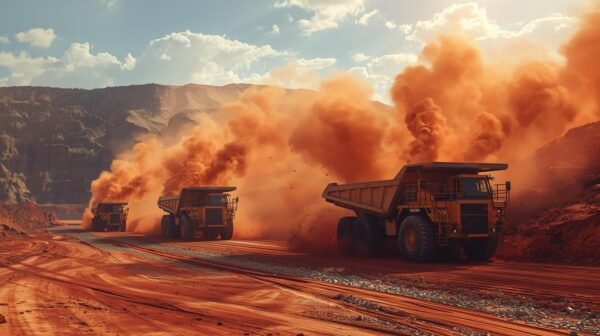
Africa’s mining sector continues its remarkable expansion, with operations spanning from the copper belts of Zambia to the gold fields of Ghana and the platinum reserves of South Africa.
At the heart of these operations lies a critical decision that shapes productivity, operational costs, and long-term profitability: selecting the right heavy-duty dump truck fleet.
For mining executives and operations managers navigating Africa’s unique challenges, this decision requires careful consideration of terrain adaptability, maintenance infrastructure, and total cost of ownership.
The African Mining Context: Why Standard Solutions Don’t Always Apply
African mining sites present distinctive operational challenges that set them apart from operations in North America, Australia, or Europe.
Extreme temperature variations, from scorching desert heat exceeding 45°C to high-altitude chill, place extraordinary demands on equipment.
Remote locations often mean limited access to specialized maintenance facilities and extended supply chains for spare parts. Infrastructure constraints, including variable road quality and sometimes unreliable fuel supplies, further complicate fleet management.
These realities make truck selection not merely a procurement exercise but a strategic decision affecting operational continuity. The wrong choice can result in excessive downtime, spiraling maintenance costs, and ultimately, compromised production targets.
Also Read:Best Heavy-Duty Trucks for Africa Construction (2026 Guide)
Caterpillar 797F: The Titan of Hauling Capacity
When payload capacity defines success, Caterpillar’s 797F stands as the undisputed heavyweight champion.
With a nominal payload capacity of 400 metric tons and powered by a 4,000-horsepower diesel engine, this mechanical marvel represents peak performance for large-scale operations.
Several Southern African platinum and iron ore mines have integrated these machines into their fleets, reporting impressive productivity gains.
The 797F’s mechanical drive system offers particular advantages in African contexts. Unlike electric-drive competitors, mechanical drive systems typically require less specialized technical expertise for field repairs, a crucial consideration where technician training levels may vary.
The truck’s robust construction and relatively straightforward hydraulics system mean that competent mechanics can address many issues without factory-trained specialists.
However, the 797F demands substantial infrastructure investment. Its sheer size requires carefully engineered haul roads with adequate width and gradients.
Initial capital outlay exceeds $5 million per unit, and fuel consumption is substantial. For operations with appropriate scale and infrastructure, though, the productivity benefits often justify these investments within three to five years.
Komatsu 930E-5: Electric Drive Excellence
Komatsu’s 930E-5 represents a compelling alternative for operations prioritizing fuel efficiency and lower emissions.
This 320-ton capacity truck employs AC electric drive technology, converting diesel engine power to electricity that drives wheel motors. The result is remarkably smooth power delivery and reduced brake wear, as the electric motors provide dynamic retarding on descents.
Several West African gold mines have reported fuel savings of 8-12% compared to mechanical drive equivalents when operating the 930E-5, a significant consideration given Africa’s sometimes volatile fuel costs and supply reliability.
The truck’s advanced traction control system proves particularly valuable in wet season conditions, maintaining productivity when other trucks might struggle.
The electric drive system does introduce complexity that requires specialized maintenance capabilities.
However, Komatsu has invested heavily in regional support infrastructure across Africa, establishing service centers and training facilities in key mining regions. For operations willing to invest in technician training, the 930E-5 offers exceptional long-term value.
Liebherr T 264: Engineering Precision Meets African Resilience
German engineering meets mining practicality in Liebherr’s T 264. This 240-ton capacity truck has earned a reputation for exceptional build quality and longevity, with many units in African service exceeding 60,000 operating hours with diligent maintenance.
Its modular design philosophy simplifies component replacement, reducing mean time to repair—a critical advantage in remote locations.
Also Read: Radial vs. Bias OTR Tires: Which Is Better for Your Mining or Construction Fleet
Liebherr’s diesel-electric drive system strikes a middle ground between mechanical simplicity and electric drive efficiency.
The company’s Africa-focused support strategy includes partnerships with local distributors who maintain parts inventories and technical specialists. This approach has proven particularly effective in East African operations, where import logistics can add weeks to parts delivery times.
The T 264’s cab design deserves special mention. Liebherr invested significantly in operator comfort and visibility, recognizing that driver fatigue impacts both safety and productivity. In the harsh conditions typical of many African sites, these ergonomic considerations translate to lower operator turnover and better performance.
Hitachi EH5000AC-3: The Value Proposition
For mid-tier operations or those expanding existing fleets, Hitachi’s EH5000AC-3 offers compelling economics. With a 296-ton payload capacity, this truck delivers substantial hauling capability at a more accessible price point than ultra-class competitors.
Several copper mining operations in Central Africa have built successful operations around EH5000AC-3 fleets, appreciating the balance between capability and capital efficiency.
Hitachi’s AC electric drive system provides many benefits of larger electric-drive trucks while maintaining manageable maintenance requirements.
The truck’s reputation for reliability in harsh conditions stems partly from conservative engineering choices that prioritize durability over maximum performance. In practice, this translates to consistent availability rates that often exceed more powerful but complex alternatives.
Making the Selection: Beyond Specifications
Choosing the optimal dump truck extends beyond comparing payload capacities and horsepower ratings.
Successful mining executives consider total cost of ownership across expected equipment life, typically 10-15 years. This calculation must include fuel costs, maintenance expenses, operator training requirements, and residual value.
Manufacturer support infrastructure in your specific region deserves careful evaluation. The most capable truck becomes a liability if parts require three-month lead times or factory technicians must fly in from distant continents for repairs.
Progressive mining companies increasingly negotiate comprehensive support agreements covering parts availability, technical training, and even performance guarantees.
Fleet standardization offers often-overlooked advantages. Operating multiple truck models may seem like risk diversification, but it multiplies training requirements, parts inventory complexity, and technical expertise needs.
Many African mining operations find that standardizing on one or two truck models, even if not individually optimal for every application, produces better overall results through simplified operations.
The Path Forward
Africa’s mining sector stands at a pivotal moment. Rising commodity prices, improving infrastructure, and advancing technology create unprecedented opportunities.
The dump trucks moving ore from pit to processing plant remain foundational to capturing these opportunities.
Whether operating at a established mine or developing a greenfield project, selecting heavy-duty dump trucks that match your operational reality—not just matching competitors’ equipment—positions your operation for sustained success.
The right choice considers not only today’s requirements but anticipated growth, evolving environmental standards, and the developing maintenance capabilities of your workforce.
In Africa’s dynamic mining landscape, strategic equipment decisions separate industry leaders from those perpetually struggling to keep pace.
Also Read
Top Compact Excavators Trends to Watch in 2026
Top 10 Construction Equipment Manufacturers in the World (2026 Ranking)

- PV Guangzhou 2027 to Highlight Solar and Energy Storage Technologies - October 22, 2026
- Accurate and Reliable Measurement and Monitoring of Industrial Plant Water Treatment - October 21, 2026
- SODECA Highlights Industrial Ventilation Technology at Mega Clima Expo Kenya 2026 - October 14, 2026