

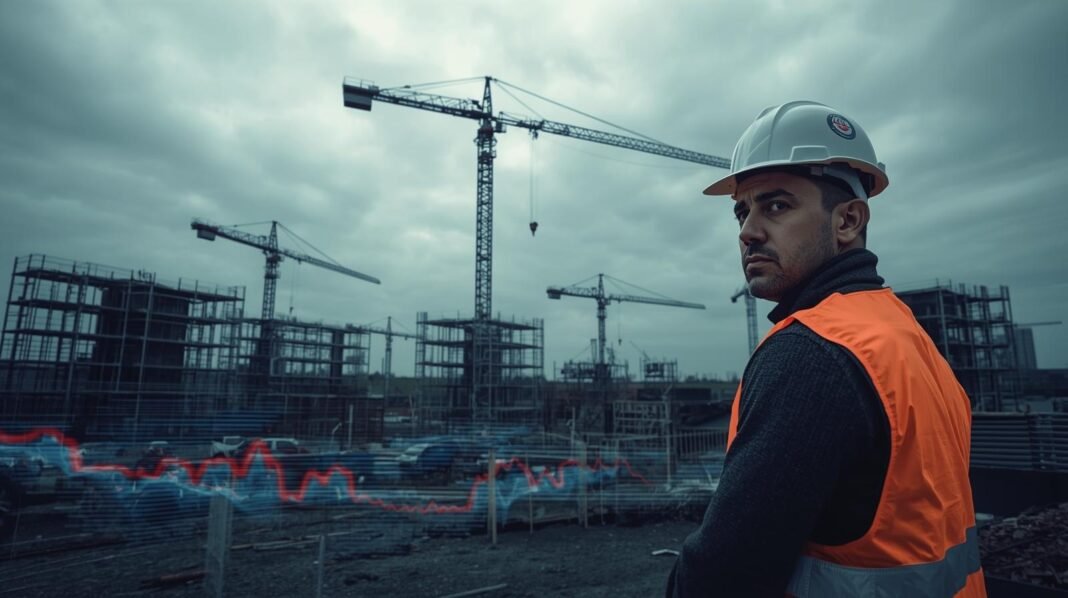
The United Kingdom’s construction industry has plunged into its most severe downturn in over five years, according to the latest industry data that paints a bleak picture of an sector grappling with collapsing confidence and vanishing order books.
Historic Decline Accelerates
November 2025 marked a watershed moment for Britain’s builders. The Construction Purchasing Managers’ Index, which measures monthly changes in total industry activity, tumbled to 39.4 from October’s already-weak 44.1.
This represented the sector’s poorest performance since May 2020, when the nation was locked down during the height of the coronavirus pandemic.
The significance of a PMI reading below 50 cannot be overstated—it signals contraction rather than growth. At 39.4, the industry isn’t just shrinking; it’s experiencing a sharp retrenchment that has now persisted for eleven consecutive months.
Every Sector Hit Hard
The malaise has spread across all corners of the industry, with no segment escaping the downturn:
Housing construction bore the brunt of the decline, with its activity index plummeting to 35.4. Commercial building work followed at 43.8, while civil engineering projects—traditionally more stable—collapsed to a dismal 30.0. Each segment recorded its steepest downturn in five-and-a-half years.
The human cost became evident in employment figures. Job losses accelerated to their fastest pace since August 2020, marking the eleventh consecutive month of workforce reductions. Companies cited not just the absence of new projects to replace completed work, but also mounting wage pressures that are squeezing already-thin margins.
The Order Book Crisis
Perhaps most concerning for the industry’s future is the collapse in new orders. Survey data revealed that 44% of firms reported declining new work, while only 17% saw increases.
Outside the pandemic period, this represents the sharpest fall in incoming business since the depths of the 2009 financial crisis.
Construction companies pointed to multiple culprits: fragile client confidence, delayed project releases, and concerns about the broader economic outlook. Many specifically cited uncertainty surrounding the Autumn Budget as prompting clients to defer investment decisions.
Mixed Signals Amid the Gloom
Not everything in the survey painted a uniformly dark picture. Supply chain pressures, which had plagued the sector for years, showed improvement.
Supplier performance strengthened solidly in November, reaching its best level since June 2024, as softer demand for construction products and materials alleviated bottlenecks.
Input costs, while still rising at an accelerated pace—particularly for electrical components, copper products, and insulation—remained below the long-run average for inflation. This suggests that at least one pressure point may be easing, even if it offers little consolation to firms struggling with empty order books.
Confidence Collapses
Looking ahead, the industry’s mood has soured dramatically. Business optimism for the year ahead slumped to its weakest level since December 2022.
While 31% of firms still expect activity to improve over the next twelve months, this is barely offset by the 25% forecasting further decline—a remarkably pessimistic outlook for a typically forward-looking sector.
Industry analysts described the data as revealing “a sharp retrenchment” driven by weak client confidence and a critical shortfall of new project starts.
Infrastructure and residential building led the downturn, though commercial construction also faced severe headwinds as business uncertainty pushed clients to postpone spending.
Structural Challenges Persist
Beyond the immediate crisis, the construction sector faces deeper structural issues. Rising labour costs, ongoing planning delays, and broader global economic headwinds continue to weigh heavily on sentiment.
The industry has also been cited as particularly vulnerable to changes in interest rates and the cost of capital, making the broader economic environment especially challenging.
More than 4,260 construction companies became insolvent in the year to September 2024, representing 16.2% of all insolvencies in England and Wales.
This vulnerability stems largely from cash flow issues, elevated interest rates, and the lingering effects of pre-pandemic commercial commitments made before the volatility of 2020-2022.
Government Ambitions vs. Reality
The dire state of the industry stands in stark contrast to the government’s ambitious plans. Policymakers have pledged to boost housebuilding and stimulate investment in UK infrastructure, with up to £775 billion earmarked for infrastructure and construction over the next decade.
However, the gulf between political aspiration and commercial reality has rarely seemed wider. Industry observers stress that construction firms can only convert resilience into growth when operating in a stable environment—something that has proven elusive in recent times.
The path forward remains uncertain. While targeted public-sector investment and gradually declining borrowing costs may eventually provide support, the sector must first navigate persistent headwinds from wage growth, compliance costs, and fundamental uncertainty about housing market prospects.
For now, Britain’s builders face the uncomfortable reality that despite government promises and infrastructure pipelines, the immediate outlook remains deeply challenging.
The question is no longer whether the downturn will continue, but how long it will take for confidence to return and order books to refill.
Also Read
SA Construction Roars Back: 10% Jump Signals Sector Revival
U.S. Construction Spending Rises Slightly in August 2025, but Underlying Weakness Persists

- From Operator to Algorithm: Bedrock Puts Autonomous Excavators to Work on Live Construction Sites - September 7, 2026
- Built For The Rough Stuff: Inside Titan’s new ForestEDGE™ Tyre Line - September 4, 2026
- South Africa Has R395 Billion in Infrastructure Projects — But Can the Industry Deliver Them? - August 26, 2026
