

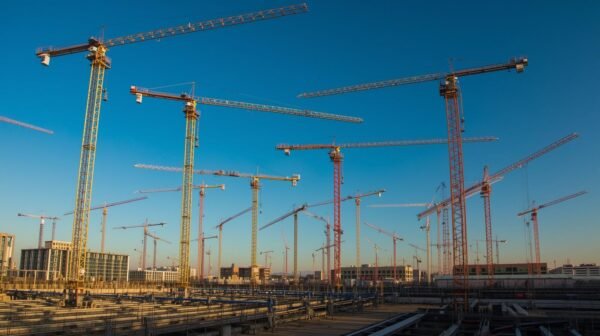
South Africa’s construction sector has posted its strongest quarterly performance in years.
Afrimat Construction Index has recorded a remarkable 10.2% quarter-on-quarter surge in the third quarter of 2025, signaling a dramatic reversal of fortunes for an industry that has long struggled under the weight of high borrowing costs and subdued economic activity.
The impressive double-digit jump marks a decisive break from the downward trajectory that characterized much of the sector’s recent performance.
The index also registered a modest 0.4% year-on-year gain, suggesting that while the recovery remains in its early stages, momentum is building across multiple fronts.
Building Materials Drive Resurgence
At the heart of this revival lies an unprecedented surge in building materials production, which achieved what economist Dr. Roelof Botha, who compiles the index on behalf of Afrimat, described as one of its strongest increases on record.
The volume of materials produced jumped 13.6% quarter-on-quarter and 5% year-on-year, reflecting renewed appetite for construction activity across both public and private sectors.
The majority of indicators tracked by the composite index recorded double-digit growth rates, painting a picture of broad-based improvement rather than isolated pockets of strength.
Hardware retail sales climbed 8% both quarterly and annually, while the value of building plans passed by municipalities showed encouraging gains.
Most significantly, construction activity outpaced overall GDP growth for the quarter—a rare achievement that underscores the sector’s emergence as a potential engine of economic expansion rather than a drag on growth.
Interest Rate Relief Fuels Optimism
The construction sector’s resurgence has been aided by monetary policy easing, with the South African Reserve Bank cutting the prime overdraft rate by 25 basis points.
Since September of the previous year, cumulative rate reductions of 125 basis points have brought the prime lending rate down to 10.25% as of November 2025, offering meaningful relief to property developers and prospective homeowners alike.
Dr. Botha remains optimistic about continued recovery, though he emphasizes that additional interest rate cuts are essential to sustain momentum.
The country’s historically high real interest rates—the differential between lending rates and inflation—have long constrained construction activity, and further easing could unlock substantial pent-up demand.
With inflation contained at modest levels and expectations anchored around the Reserve Bank’s target range, economists anticipate further rate reductions throughout 2025 and into 2026, potentially bringing the prime rate below 10% and creating conditions more conducive to sustained construction growth.
Private Sector Steps Up as Public Investment Lags
While the overall picture is encouraging, not all indicators are flashing green. The value of construction works—heavily dependent on government infrastructure spending—remained the lone metric to decline, highlighting persistent challenges around weak capital formation and the government’s limited appetite for large-scale infrastructure investment.
This shortfall in public sector activity has placed greater emphasis on private sector initiatives to drive growth.
Afrimat CEO Andries van Heerden noted that while the company hasn’t yet witnessed a massive uptick in infrastructure development and maintenance, small pockets of demand are emerging across provincial and private sector projects.
Van Heerden attributed Afrimat’s improved performance to strategic acquisitions, including the integration of its Lafarge cement operations, which have reached break-even status.
The company has also reopened previously idle quarries in response to strengthening demand for aggregates and cement, positioning itself to capitalize on the sector’s nascent recovery.
Employment Gains Offer Hope
One particularly encouraging aspect of the construction rebound has been its impact on job creation.
While employment in the sector rose only modestly by 0.7% year-on-year, this represents a reversal of the job losses that characterized much of the post-pandemic period.
Construction remains one of South Africa’s most labor-intensive sectors, and sustained growth could generate significant employment opportunities in communities hardest hit by unemployment.
The sector’s recovery assumes added importance given South Africa’s chronic unemployment crisis, which has kept joblessness stubbornly elevated despite broader economic stabilization.
Additional construction activity, particularly in housing and infrastructure, could provide pathways to employment for low-skilled workers while stimulating demand across related industries.
Infrastructure Deficit Looms Large
Despite the positive quarterly results, South Africa’s construction sector continues to grapple with fundamental structural challenges. The country’s infrastructure deficit—spanning ports, rail logistics, roads, and utilities—remains a critical constraint on economic growth and competitiveness.
Industry leaders emphasize that addressing this backlog will require greater collaboration between public and private sectors, along with reforms to streamline tender processes and reduce bureaucratic obstacles that have historically delayed major projects.
Recent moves toward public-private partnerships in infrastructure development offer some promise, though execution remains uneven.
The residential property market also faces headwinds, with home loan applications having declined substantially during the period when interest rates peaked at their highest levels in 14 years.
However, early signs suggest this trend may be reversing as rate cuts gain traction and consumer confidence improves under the Government of National Unity.
Outlook: Cautious Optimism Prevails
Looking ahead, economists and industry participants express cautious optimism about the construction sector’s trajectory.
The combination of easing monetary policy, improved business confidence, and selective increases in provincial spending creates a more supportive environment than has existed in several years.
Dr. Botha emphasized that while modest policy easing is welcome, bringing South Africa’s cost of capital in line with key trading partners will require additional rate cuts.
The Reserve Bank’s commitment to a gradual easing cycle, combined with inflation forecasts that remain well-anchored, suggests room for further accommodation in coming quarters.
For the construction industry, much will depend on whether the current momentum can be sustained and broadened.
The reopening of idle quarries, break-even performance at cement plants, and rising demand for building materials all point toward improving fundamentals. However, without a corresponding commitment to infrastructure investment from government, the sector’s growth potential may remain constrained.
What is clear is that after years of stagnation, South Africa’s construction sector has finally turned a corner.
The question now is whether this quarter’s impressive performance represents a temporary blip or the beginning of a sustained recovery that could help drive broader economic transformation.
With interest rates heading lower and demand showing signs of life, the answer may soon become apparent.
Dr. Botha remains cautiously optimistic but emphasizes the critical role of government action in sustaining this momentum.
“The lack of progress with capital formation in the economy, which is generally associated with a significant element of construction works, should be of concern to the government, as the country is in dire need of repairs and expansion of infrastructure, especially roads, water and sewerage,” he stated.
Looking ahead, he expects continued recovery in construction sector activity, but with an important caveat: “While the modest easing of monetary policy is welcome, additional interest rate cuts are needed to bring the cost of capital in South Africa in line with our key trading partners.”
Also Read
U.S. Construction Spending Rises Slightly in August 2025, but Underlying Weakness Persists
At Risk: 330,000 Solar Jobs Could Vanish — What Companies Are Doing to Prepare

- How They Were Built: Inside the Engineering of the Lesotho Highlands Water Project - October 11, 2026
- Africa’s Water Reuse Opportunity: Building the Infrastructure for a Water-Secure Future - September 28, 2026
- Why Water Reuse Is Becoming a Business Imperative for African Industry - September 28, 2026