
The paradox couldn’t be starker. Nvidia just delivered one of the most spectacular earnings reports in corporate history—revenue soaring 62% to $57 billion, profits up 65%, and a CEO confidently declaring that demand for AI chips is “off the charts.”
Yet the stock promptly fell 3%, erasing tens of billions in market value and extending a November selloff that has the entire tech sector on edge.
Welcome to the week of November 24, 2025, where a shortened Thanksgiving trading session and a packed earnings calendar could determine whether artificial intelligence remains Wall Street’s favorite story or becomes its most expensive cautionary tale.
The No-Win Scenario: When Great Isn’t Good Enough
Despite reporting strong third-quarter results and an optimistic sales forecast, Nvidia saw its stock drop 3.2% on November 20, contributing to an almost 11% loss for the month and placing it in correction territory.
The AI chip giant’s market cap hemorrhaged an estimated $450 billion over three days in early November.
Nvidia CEO Jensen Huang addressed the absurdity directly at a recent company meeting, acknowledging his company faces an impossible situation: strong results fuel bubble accusations, while weak results confirm them.
It’s a sentiment echoing across the entire tech sector as investors wrestle with a fundamental question—are trillion-dollar AI infrastructure bets visionary investments or history’s most expensive act of speculation?
A November 2025 Bank of America Global Fund Manager Survey revealed that 45% of asset allocators identify an AI bubble as the biggest tail risk, with 53% believing AI investments are excessive.
Also Read: 5 Stocks Analysts Are Watching Closely as 2025 Winds Down
That’s up sharply from just 33% the previous month, signaling rapidly deteriorating sentiment even as AI companies continue posting robust growth.
This Week’s Reckoning: The Earnings That Matter
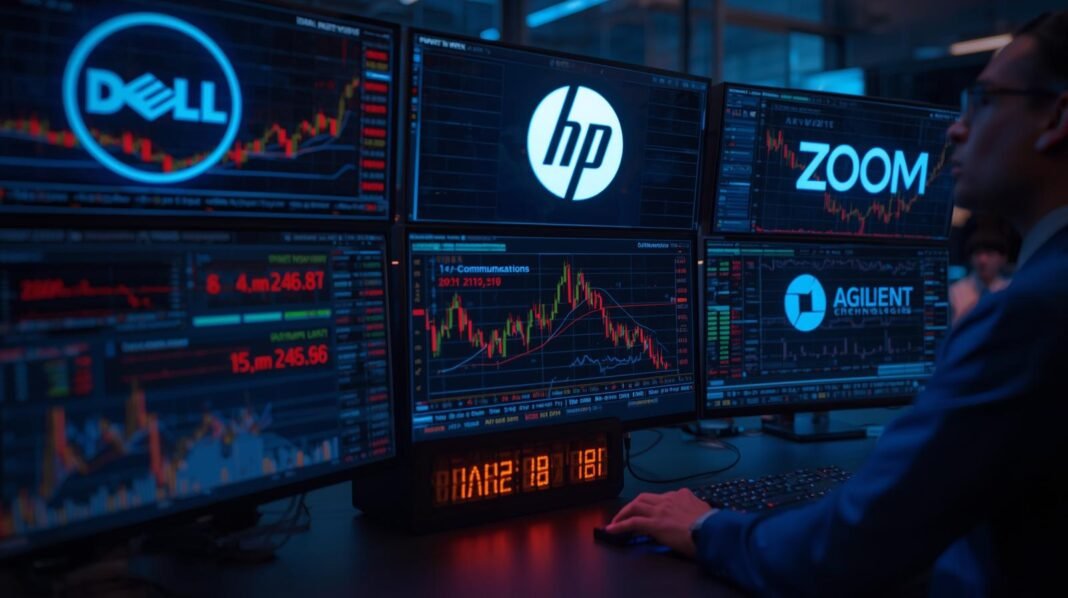
Into this volatile environment comes a condensed earnings calendar that reads like a who’s who of AI-adjacent technology: Dell, HP, Zoom, Autodesk, Workday, Best Buy, Analog Devices, and others all reporting between Monday and Wednesday before markets close early for Thanksgiving.
The compression matters. Because Thursday is a full market holiday and Friday is a short session with a 1 PM ET close, price reactions to midweek earnings may be amplified by lower liquidity.
In other words, any hint of AI spending weakness or cautious guidance could trigger outsized moves in already-jittery markets.
Monday, November 24: The Opening Salvo
Zoom Communications (after close, 5:00 PM ET call)
- Expected revenue: $1.21-$1.22 billion (low single-digit growth)
- Key focus: Uptake of AI-powered collaboration tools
- Why it matters: Zoom represents enterprise software demand and whether companies are willing to pay premiums for AI features
Symbotic (after close)
- The AI warehouse automation company
- Options pricing implies a move over 20% around earnings, underscoring how sensitive sentiment is in AI and robotics plays
- Why it matters: High-beta AI stocks could signal whether speculative money is fleeing or holding firm
Agilent Technologies and Keysight Technologies (after close)
- Keysight sits at the intersection of 5G, semiconductor, and defense spending—all critical for assessing the durability of the tech capex cycle
- Why it matters: These testing equipment makers serve as canaries in the coal mine for semiconductor demand
Tuesday, November 25: The Main Event
Dell Technologies (before open)
- Analysts expect Q3 revenue near $27.27 billion and EPS around $2.48, both pointing to healthy double-digit growth
- Management raised full-year guidance after Q2’s blowout: record $29.8 billion revenue, ISG up 44%, servers and networking up 69%, with $8.2 billion in AI server shipments and an $11.7 billion AI backlog
- The complication: Morgan Stanley and Bank of America both trimmed price targets citing pressure from rising memory costs, though BofA still sees earnings potentially topping $19 per share by 2030
- Why it matters: Dell is Nvidia’s most important partner for AI servers. Any commentary about customer hesitation or Blackwell chip delays will reverberate across the entire AI infrastructure ecosystem
HP Inc. (after close)
- Focus on PC market recovery and AI PC adoption
- Why it matters: Consumer and enterprise willingness to upgrade for AI capabilities
Autodesk (after close, 5:00 PM ET call)
- Analysts expect EPS of $2.49 on revenue of $1.8062 billion
- Why it matters: Design software giant’s commentary on construction and manufacturing sectors signals broader capital spending trends
Workday (after close)
- Enterprise cloud applications for HR and finance
- Why it matters: Another read on whether companies are expanding or contracting software budgets
Best Buy (before open)
- Analysts expect earnings of $1.31 per share, up 4% year over year, on revenue of $9.59 billion
- Why it matters: Consumer electronics demand heading into holidays; any mention of AI PC or device adoption
Also Read:Brazilian Crypto Firm Rental Coins Files for Bankruptcy
The Subtext: What Analysts Are Really Watching
Any commentary on AI spending during Zoom, Symbotic, Dell, or Nvidia-adjacent calls this week could move not just those stocks, but the broader market narrative. Investors will scrutinize management language for three key signals:
- Budget discipline: Are customers tightening AI spending or proceeding full speed ahead?
- Project delays: Are enterprises pushing back AI deployments to wait for better economics or next-generation hardware?
- Return on investment: Can anyone articulate tangible productivity gains or revenue growth from their AI investments?
The stakes couldn’t be higher. The combined market capitalization of the Magnificent 7—Alphabet, Amazon, Apple, Meta, Microsoft, Nvidia and Tesla—today represents a record 37% of the S&P 500’s total value.
If these companies and their ecosystem partners stumble, the index has little cushion.
The Bubble Debate: Two Sides, Same Data
The Bears: This Is 1999 All Over Again
The startling run-up in AI-related stocks is prompting comparisons to the dot-com era of the late 1990s, when many internet companies saw their stock prices skyrocket despite suffering vast financial losses. When that bubble burst, it torched portfolios and triggered a recession.
Several concerning parallels stand out:
Circular Financial Engineering: OpenAI is now taking a 10% stake in AMD, while Nvidia is investing $100 billion in OpenAI; OpenAI also counts Microsoft as one of its major shareholders, but Microsoft is also a major customer of CoreWeave, which is another company in which Nvidia holds a significant equity stake.
The lines between customer, investor, and supplier have blurred to the point of absurdity.
Concentration Risk: The stock market is a giant bet on AI right now, with the year’s 15% gain in the S&P 500 largely due to a handful of tech giants heavily investing in AI. UBS strategist Andrew Garthwaite notes classic bubble patterns: buy-the-dip mentality, “this time is different” rhetoric, increased retail participation, and earnings growth confined to the top ten companies.
Spending Without Returns: Tech companies are projected to spend $400 billion this year on AI infrastructure. That’s more than any group of firms has ever spent to do just about anything—the equivalent of funding a new Apollo moon program every ten months.
Yet concrete evidence of productivity gains or revenue growth remains elusive.
Extreme Valuations: AI-related capital expenditures surpassed the US consumer as the primary driver of economic growth in the first half of 2025, accounting for 1.1% of GDP growth, with AI-related stocks accounting for 75% of S&P 500 returns, 80% of earnings growth and 90% of capital spend.
The Bulls: This Is Real, Not Speculation
Not everyone sees disaster ahead. Major investors managing hundreds of billions argue the AI boom fundamentally differs from past bubbles.
Profitable Giants, Not Startups: During the dotcom bubble, all the capital was fueled by IPOs and new companies with fairly dubious business models. Today, the biggest publicly traded tech companies are on their way to producing close to $1 trillion of free cash flow annually, doing so with no significant debt.
Supply Constraints, Not Speculation: CoreWeave’s revenue backlog nearly doubled quarter-over-quarter to $55.6 billion, yet the company slashed its 2025 capital expenditure guidance by up to 40%, citing delayed power infrastructure delivery. Oracle CEO Safra Catz confirmed the firm is “still waving off customers” despite a $455 billion revenue backlog due to capacity shortages.
Portfolio manager Ben Visser argues: “This is not the dot-com bubble, because demand is massively outpacing supply. The next AI investment phase will not be defined by who can spend the most, but by who can execute through constraint”.
Reasonable Valuations Relative to History: Goldman Sachs indicates that the median 24-month forward price-to-earnings ratio for today’s Magnificent Seven stands at 27 times earnings—nearly half the median valuation of top tech stocks during the 2000 bubble.
Sustained Earnings Growth: While AI stock prices have appreciated strongly, this has been matched by sustained earnings growth, not mere speculation, with the current scenario reflecting broader macroeconomic conditions: low interest rates, high global savings, and a long economic cycle.
The Crypto Connection: When Risk Assets Collapse Together
Adding fuel to bearish sentiment is crypto’s spectacular November implosion. Bitcoin has dropped roughly 25-30% this month, falling from an October peak above $120,000 to the low-$80,000 range.
The cryptocurrency’s decline triggered tens of billions in leveraged liquidations and is on track for its worst month since the 2022 collapse.
Analysts say the drop reflects a flight from risky assets, driven by worries over high tech valuations and the uncertain Fed path. The contagion effect is real—when speculative assets crash, investors reassess all high-risk positions, including expensive tech stocks.
The Fed Factor: Bad Timing for Uncertainty
Complicating everything is confusion about Federal Reserve policy. Odds of a December rate cut have whipsawed dramatically, swinging from 97% certainty in mid-October to as low as 22% according to some economist polls, before rebounding to around 60-70% after dovish comments from New York Fed President John Williams.
The problem: a government shutdown created a data blackout, delaying the November jobs report until December 16—after the Fed’s December 9-10 meeting.
Policymakers will make their decision without fresh labor market data, relying instead on delayed September figures and high-frequency indicators like jobless claims.
For tech stocks trading at premium valuations based on long-term growth expectations, the Fed’s path matters enormously. Higher rates make future earnings less valuable today, disproportionately affecting growth stocks.
Also Read:Inside Eli Lilly’s Trillion-Dollar Breakthrough: How Weight-Loss Drugs Are Changing Pharma
What to Watch This Week
As earnings roll out Monday through Wednesday, here are the key indicators that could shift market sentiment:
Language Around AI Budgets
- Are customers proceeding with planned deployments or reconsidering?
- Any mentions of “optimization,” “rationalization,” or “reprioritization” spell trouble
- Conversely, phrases like “ahead of schedule,” “expanding scope,” or “additional projects” signal strength
Margin Pressure Commentary
- Dell and HP will address rising memory costs
- Any guidance cuts due to component inflation could spark broader sector concerns
- Strong margins despite cost pressures would be reassuring
Demand Duration
- Is AI infrastructure demand a multi-year cycle or approaching saturation?
- Dell’s commentary on its $11.7 billion backlog will be crucial
- Any mentions of order pushouts or cancellations would be devastating
Enterprise Software Adoption
- Zoom, Workday, and Autodesk represent whether companies beyond hyperscalers are embracing AI
- Low uptake of AI-powered features suggests the technology isn’t delivering value
- Strong attach rates for AI upgrades validate the investment thesis
Consumer Appetite
- Best Buy’s read on AI PCs and consumer electronics
- Any signs of trade-down behavior or delayed purchases matter for holiday forecasts
The Bigger Picture: A Market at an Inflection Point
The technology sector’s turbulence in November 2025, driven by AI bubble fears and a widespread selloff, underscores a critical period of maturation for the AI industry and the broader market, with investors increasingly scrutinizing valuations and demanding tangible returns on AI investments.
This week’s earnings represent more than quarterly scorecards—they’re a referendum on whether the AI revolution remains on track or requires a painful reset of expectations.
The market has essentially priced in perfection, with tech valuations stretched and concentration risk at record levels.
Three scenarios could emerge from this week’s results:
Scenario 1: Validation – Strong results across the board with confident AI spending commentary could reignite the rally, suggesting concerns were overblown and the bull market has room to run.
Scenario 2: Mixed Signals – Some companies beat while others miss, with divergent AI spending trends. This muddled picture likely extends volatility as investors struggle to discern the true trajectory.
Scenario 3: Reality Check – Widespread disappointments or cautious guidance trigger a broader tech selloff, potentially accelerating the rotation into defensive sectors and value stocks that’s already begun.
Given thin holiday trading volumes and already-elevated anxiety levels, reactions could be exaggerated in either direction. The VIX—Wall Street’s fear gauge—remains elevated, reflecting heightened uncertainty about what comes next.
The Long View: Bubble or Revolution?
Here’s what often gets lost in the bubble debate: both sides can be right. The 1990s fiber-optic buildout was absolutely a bubble that destroyed countless companies and wiped out billions in capital. It also laid the groundwork for the internet economy that followed.
The question isn’t whether AI is transformative—most serious analysts agree it is. The question is whether current valuations and spending levels are justified by near-term returns, or whether we’re in the classic boom-bust cycle where infrastructure gets built ahead of the business models that monetize it.
While the recent selloff has been sharp, many analysts view it as a healthy correction, necessary to flush out excessive speculation and reset valuations, with the underlying momentum for AI capital expenditures remaining robust.
Also Read: What’s Actually Breaking Bitcoin Right Now? The Tariff, Fed, and ETF Outflow Trifecta Explained
This week’s earnings will provide crucial data points. If companies like Dell can demonstrate sustained demand with visibility into 2026, if software firms like Zoom and Workday show enterprises adopting AI features at healthy rates, and if Best Buy signals consumers are actually buying AI-enabled devices, the bull case strengthens considerably.
But if guidance disappoints, if commentary suggests customers are tapping the brakes, or if margins compress more than expected, the market’s November anxieties could intensify into something more serious—a genuine reassessment of AI economics that forces valuations lower across the board.
The Bottom Line
The AI bubble anxiety gripping markets as 2025 winds down reflects genuine uncertainty about whether trillions in infrastructure spending will generate commensurate returns.
Bubbles occur when stocks surge on inflated growth expectations that ultimately prove to be disconnected from a company’s underlying fundamentals.
This Thanksgiving week’s compressed earnings calendar offers a critical test. In an environment where even spectacular results from Nvidia couldn’t sustain a rally, the bar for satisfaction has risen dramatically.
Investors want more than strong numbers—they want proof that AI spending is rational, sustainable, and ultimately profitable.
The market will get its answers starting Monday night. And with thin liquidity, elevated volatility, and record concentration in a handful of AI-related names, those answers will likely move stocks violently in one direction or the other.
For investors, the message is clear: this isn’t a week to be complacent. The earnings reports landing between now and Wednesday afternoon could define tech sector direction for months to come.
Whether AI emerges as the most important technology investment of the 21st century or the most expensive lesson in speculation depends largely on what management teams say—and don’t say—about the sustainability of current spending levels and the tangible returns being generated.
The AI revolution may be real. But revolutions don’t proceed in straight lines, and valuations don’t rise indefinitely. This week, we’ll learn which truth the market believes more.
Also Read
Are Verizon’s Layoffs a Warning for White-Collar Jobs in the AI Era?
Walmart’s Earnings Jump: What This Means for Investors and Consumers

