

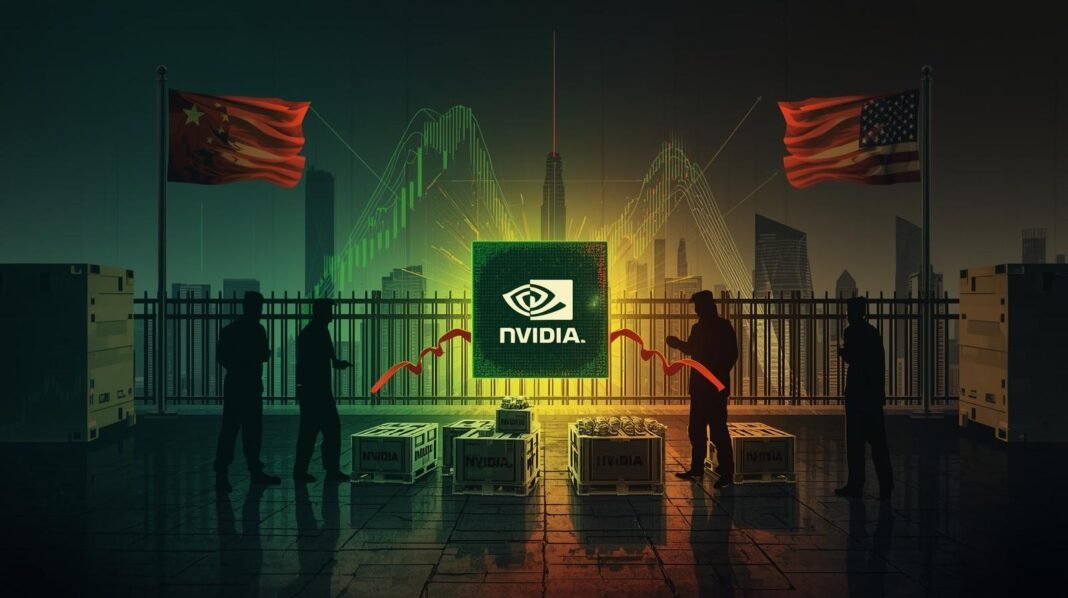
Nvidia Corp. tumbled in early trading Wednesday after China ordered its largest technology companies to halt purchases of a key artificial intelligence processor, a move that deepens the U.S.–China tech standoff and clouds the outlook for one of Wall Street’s most valuable firms.
The Cyberspace Administration of China (CAC) instructed firms including ByteDance Ltd., Alibaba Group Holding Ltd., and Tencent Holdings Ltd. to cancel existing orders and suspend testing of the RTX Pro 6000D, according to people familiar with the matter.
The directive effectively shutters one of the last channels through which Nvidia had been supplying advanced chips to Chinese companies.
The decision underscores Beijing’s resolve to reduce reliance on U.S. semiconductors and accelerate its support for domestic suppliers such as Huawei Technologies Co. and Biren Technology.
It also raises the stakes for Nvidia, which had been navigating between Washington’s export curbs and China’s demand for AI hardware.
Nvidia’s Market Fallout
Shares of Nvidia fell 5.4% in premarket trading in New York, wiping out roughly $85 billion in market value. Analysts warned that further downside could follow if the ban extends to additional Nvidia models designed for the Chinese market.
“China represented as much as 25% of Nvidia’s data center revenue before export controls, so the earnings impact could be material,” said Tom Richardson, a semiconductor analyst at Bernstein.
“This is not a one-quarter problem — it points to a structural decline in access to a critical market.”
Other chipmakers were also caught in the downdraft. Taiwan Semiconductor Manufacturing Co., which fabricates Nvidia’s GPUs, dropped in Taipei trading. Samsung Electronics Co. edged lower in Seoul, reflecting concerns about weakening demand from U.S. AI chipmakers.
By contrast, Chinese semiconductor stocks rallied. SMIC surged in Hong Kong, while Cambricon Technologies Corp. rose on bets that Beijing will accelerate orders for local AI processors. Huawei’s Ascend chip unit is also expected to benefit as domestic firms reallocate budgets.
Strategic Shift
The CAC’s order follows months of informal pressure on Chinese firms to scale back use of Nvidia’s H20 chip, one of the few models still available after Washington tightened export restrictions in 2023. By moving against the RTX Pro 6000D, Beijing is signaling a willingness to absorb short-term setbacks in AI development in exchange for longer-term technological sovereignty.
“This is less about performance today and more about national security tomorrow,” said a Shanghai-based consultant advising local internet firms. “China would rather slow its AI rollout briefly than remain permanently dependent on U.S. suppliers.”
For Nvidia, the timing is critical. The company’s data-center division, driven by surging demand for AI model training, has been the main engine of its trillion-dollar valuation. Losing access to China could force Nvidia to lean more heavily on U.S. hyperscalers like Microsoft, Amazon, and Google, while looking for growth in regions such as the Middle East.
Market Impact at a Glance
-
Nvidia Corp.: Shares fell 5.4% premarket, erasing about $85B in market cap. Risk of deeper losses if ban expands to other models.
-
TSMC / Samsung Electronics: Both declined in Asian trading on concerns over reduced demand from Nvidia.
-
Chinese Chipmakers: SMIC and Cambricon surged; Huawei’s Ascend unit seen as a major beneficiary.
-
AI Market Outlook: China’s ban could cut up to 25% of Nvidia’s data-center revenue pipeline, pressuring earnings forecasts.
-
Global Investors: Analysts warn of higher geopolitical risk premiums for semiconductor equities; rotation into China-backed chipmakers observed.
-
Debt Markets: Yields widened slightly on U.S. tech debt as traders priced in weaker cash flow for chip suppliers.
Global Implications
The move adds to volatility across equity markets already sensitive to geopolitical risks. Investors had bid up semiconductor stocks to record highs on expectations that AI demand would offset cyclical downturns in consumer electronics. China’s clampdown throws that assumption into question.
“The U.S.–China chip war has officially entered a two-way restriction cycle,” said Monica Lee, head of Asia technology strategy at Nomura.
“Washington cut off supply with export controls, and now Beijing is closing its own market. For global investors, this means higher risk premiums for the entire semiconductor sector.”
Bond markets also reflected the uncertainty. Yields on U.S. tech-heavy corporate debt widened modestly as traders priced in earnings headwinds for Nvidia and its suppliers. Meanwhile, Asian equities saw a rotation, with capital flowing out of Korean and Taiwanese chipmakers into Chinese state-backed players.
Outlook
While Nvidia has not commented publicly on the CAC’s directive, the company faces limited options.
Any attempt to design new “China-compliant” chips could be undercut by further restrictions from either Washington or Beijing. Analysts say the likeliest outcome is that China will become effectively closed to U.S. AI hardware within the next two years.
For investors, that could mean the end of a key growth pillar for Nvidia, even as AI demand continues to expand globally. “This doesn’t kill the AI boom,” said Bernstein’s Richardson, “but it reshapes who benefits from it — and investors need to start pricing in that shift.”

- Wastewater Infrastructure in Africa: The Equipment Driving Next-Gen Utilities - July 15, 2026
- US Warehouse Construction Bottoms Out: Why Cushman & Wakefield Sees 2026 as the Turning Point - July 15, 2026
- US Mortgage Rates Climb Toward 6.8% as Housing Affordability Squeeze Deepens Into Summer - July 15, 2026
