
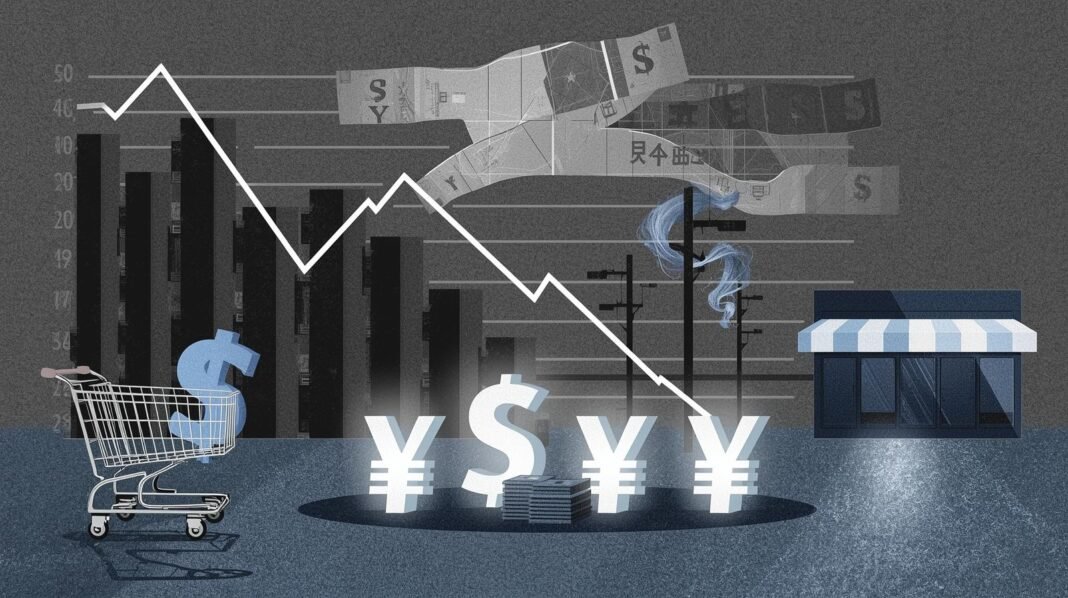
China’s battle against economic headwinds continues as new data reveals a persistent slide into deflation, raising concerns about the nation’s growth trajectory and its ripple effects across the global economy.
The National Bureau of Statistics reported on Wednesday that the consumer price index (CPI), a key measure of inflation, fell by 0.4% in August 2025 compared to the previous year, deepening worries that falling prices are becoming a lasting feature of the economic landscape.
This latest figure marks a return to negative territory after a brief stabilization in July, underscoring the fragility of consumer demand and the mounting challenges facing policymakers.
Deflation, a period of consistently falling prices, can stifle economic growth by discouraging spending and investment, as consumers and businesses delay purchases in anticipation of even lower prices.
This can lead to a difficult-to-break cycle of reduced profits, lower wages, and shrinking economic activity.
Several factors are contributing to China’s deflationary woes. A significant driver behind the August decline was a sharp drop in food prices, which fell 4.3% year-over-year.
While welcome news for household budgets, this steep decline points to sluggish consumer activity and an oversupply in some agricultural sectors.
Beyond food, the core issue is a broader weakness in domestic demand. An uncertain economic outlook, coupled with a prolonged property sector crisis, has left consumers hesitant to spend.
This cautious sentiment has become entrenched, weighing heavily on everything from retail sales to big-ticket purchases.
“The data confirms that the deflationary risk is not a fleeting issue but a deep-seated problem tied to confidence,” said a senior economist at a Shanghai-based financial group.
“Without a significant rebound in consumer and business confidence, it’s difficult to see how this trend reverses on its own. The ‘wait-and-see’ approach is becoming the new norm.”
The pressure is not limited to consumer prices. The producer price index (PPI), which measures costs for goods at the factory gate, has also been in decline, though it showed signs of easing in August.
This factory-level deflation indicates that manufacturers are struggling with weak demand both at home and abroad, forcing them to cut prices to move inventory.
The situation presents a significant dilemma for Beijing. In response, authorities are expected to consider further policy interventions.
Potential measures include more aggressive interest rate cuts by the People’s Bank of China to lower borrowing costs and stimulate lending.
Additionally, fiscal stimulus, such as government spending on infrastructure or direct support for consumers, may be necessary to inject momentum into the economy.
However, policymakers are treading carefully, wary of exacerbating debt levels. The effectiveness of any response will depend on its ability to restore confidence among China’s 1.4 billion consumers.
The implications extend far beyond China’s borders. As a central hub of global manufacturing and trade, sustained deflation in China could mean exporting lower prices worldwide.
While this might offer temporary relief for inflation-hit Western economies, it also signals weakening global demand, posing a risk to international companies reliant on the Chinese market.
As the world watches, the question is whether Beijing’s next moves will be bold enough to pull the world’s second-largest economy out of its deflationary spiral and back onto a path of stable growth.
For now, the latest price data serves as a clear signal that the path ahead remains challenging.
Also Read
AI-Powered Cloud Mining: Green Profits in 2025
S&P 500 Reaches New All-Time High as Inflation Cools, Fueling Rate Cut Hopes

- Mega Machines: The World’s Most Powerful Drilling Rigs - June 29, 2026
- The R33 Billion Rare Earth Opportunity: Why Investors Are Watching South Africa - June 27, 2026
- Mega Machines: The World’s Largest Motor Graders - June 27, 2026
