
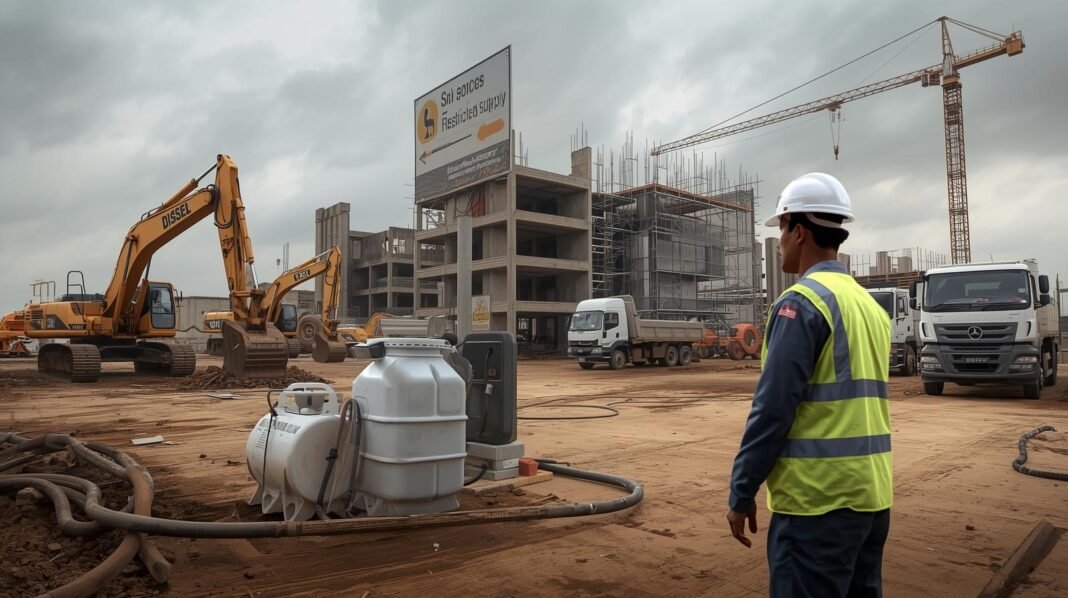
South Africa fuel restrictions are sending shockwaves through the construction industry.
What started as a rationing crisis among agricultural cooperatives in early March 2026 is rapidly becoming a cost and logistics headache for site managers, plant operators and contractors across the country.
If your business runs diesel-powered equipment — excavators, graders, concrete mixers, generators or delivery fleets — the next 60 days demand your full attention.
On 9 March, OVK Limited in the Eastern Cape suspended diesel orders at its distribution points, citing untenable price increases from its own fuel suppliers. VKB Group followed by capping sales at 80 litres per customer per day.
While these restrictions were directed at farming customers, they signal the wider supply and pricing pressure now rippling across every diesel-dependent industry — and construction is one of the most exposed.
Why South Africa Fuel Restrictions Hit Construction Hardest
Unlike office-based businesses, construction companies cannot simply absorb or defer fuel costs.
Diesel is a direct, non-negotiable operational input. A typical mid-size construction site might run multiple pieces of yellow metal simultaneously — excavators consuming 15 to 25 litres per hour, TLBs, compactors, water bowsers and site generators all drawing from the same fuel supply.
Add a ready-mix concrete fleet and materials delivery trucks to that equation and daily fuel bills run into the tens of thousands of rands on larger contracts.
The South Africa fuel restrictions now emerging are compounding an already difficult pricing environment.
The Central Energy Fund’s mid-cycle data points to a diesel price increase of up to R6.02 per litre in April 2026 — potentially pushing 50ppm diesel toward R25 per litre and approaching the record high of R25.75 set in October 2022.
New fuel levies from the 2026 Budget, adding approximately 21 cents per litre, take effect at the same time.
For context: a contractor running 10,000 litres of diesel per month — modest by industry standards — would face an additional monthly cost of around R60,000 based on current projections. On a fixed-price or lump-sum contract, that increase comes directly off the bottom line.
Contract Risk: Are You Covered?
The most urgent question for contractors right now is whether their existing contracts contain fuel escalation clauses.
Many standard JBCC and NEC contracts in South Africa include provisions for price adjustment tied to published indices — but the specific wording matters enormously.
If your contract references the diesel pump price as a fluctuation input, the April increase may trigger an adjustment claim. If it does not, you may be carrying the full exposure.
The South Africa fuel restrictions developing right now constitute a foreseeable — but arguably force majeure-adjacent — cost event, particularly given the global trigger of the US-Iran conflict and its disruption to Strait of Hormuz shipping.
Contractors on long-duration contracts signed before the current oil price spike should review their contract terms carefully and seek legal or quantity surveying advice before the April price adjustment lands.
Clients and developers should equally be preparing for variation claims. Proactive communication now — before costs crystallise — is far preferable to a disputed extension of time or loss-and-expense claim later.
Supply Chain Knock-Ons: More Than Just Diesel
South Africa fuel restrictions have a multiplier effect that goes beyond the direct cost of filling equipment tanks.
Every element of a construction project’s supply chain that moves on a truck becomes more expensive when diesel prices rise.
Cement deliveries, steel and rebar, aggregates, bricks and blocks, timber, drainage pipes — all of it travels on diesel. Suppliers will begin adjusting their delivered prices to contractors within weeks of the April pump price change, if not before.
The Middle East conflict is also disrupting global shipping more broadly, affecting lead times and costs for imported construction materials including structural steel, electrical components, and specialist plant equipment.
Contractors relying on imported products should be confirming delivery schedules and pricing with suppliers now, before any further escalation.
Practical Steps for Contractors Facing South Africa Fuel Restrictions
The first priority is to audit your current fuel procurement arrangements. Are you buying from a single supplier on a day-rate basis, or do you have a bulk supply agreement with price certainty?
The South Africa fuel restrictions emerging at cooperative level have not yet extended to commercial filling stations, but price volatility at the pump is a near certainty in April.
Contractors with bulk storage capacity should consider topping up strategic reserves now, while prices are still at current levels.
Second, review your plant and equipment schedules for efficiency. Idling time is particularly costly during fuel price spikes.
Modern telematics systems can flag excessive idling, and simple operational discipline — switching off equipment between cycles, right-sizing machines to tasks — can reduce consumption meaningfully without affecting productivity.
Third, if you are tendering new work in the current environment, build realistic fuel cost assumptions into your pricing.
Using today’s prices without an escalation buffer on contracts that will run through mid-2026 and beyond is a significant risk.
The Department of Mineral and Petroleum Resources has confirmed that South Africa fuel restrictions on ordinary supply are not imminent — but price escalation is. Those are different risks, and both need to be priced.
The Bigger Picture: South Africa Fuel Restrictions and the Construction Economy
The broader economic context of South Africa fuel restrictions deserves attention. Infrastructure investment — roads, housing, water and energy projects — is the lifeblood of South Africa’s construction pipeline.
Much of this work is government-funded, and government budgets are set in advance. A sharp, unplanned diesel cost increase has the potential to stall projects, reduce tender competition, or force value engineering that compromises quality.
The rand’s current weakness — trading between R16.54 and R16.79 to the dollar — is amplifying the global oil price shock at a local level.
Until either the conflict de-escalates or the currency strengthens, South Africa fuel restrictions and price pressure will remain a structural challenge rather than a short-term blip.
For construction businesses, the message is clear: the time to act on South Africa fuel restrictions is now, not when the April price hike arrives on your fuel invoice.
Review your contracts, lock in your supply where possible, communicate with your clients, and price your new tenders accordingly.
The companies that manage this proactively will be in a far stronger position than those who don’t.
Also Read
Oil at $100: How the Hormuz Shock Is Reshaping Industry Worldwide
Oil Breaks $100: What the Surge Means for Your Construction Business

