
Stockholm| April 1, 2026: Swedish mining equipment manufacturer Epiroc has won a large order for autonomous and electric surface mining equipment in Africa, the company announced in March 2026.
The order is valued at SEK 380 million (approximately $40.7 million) and was booked in the first quarter of 2026.
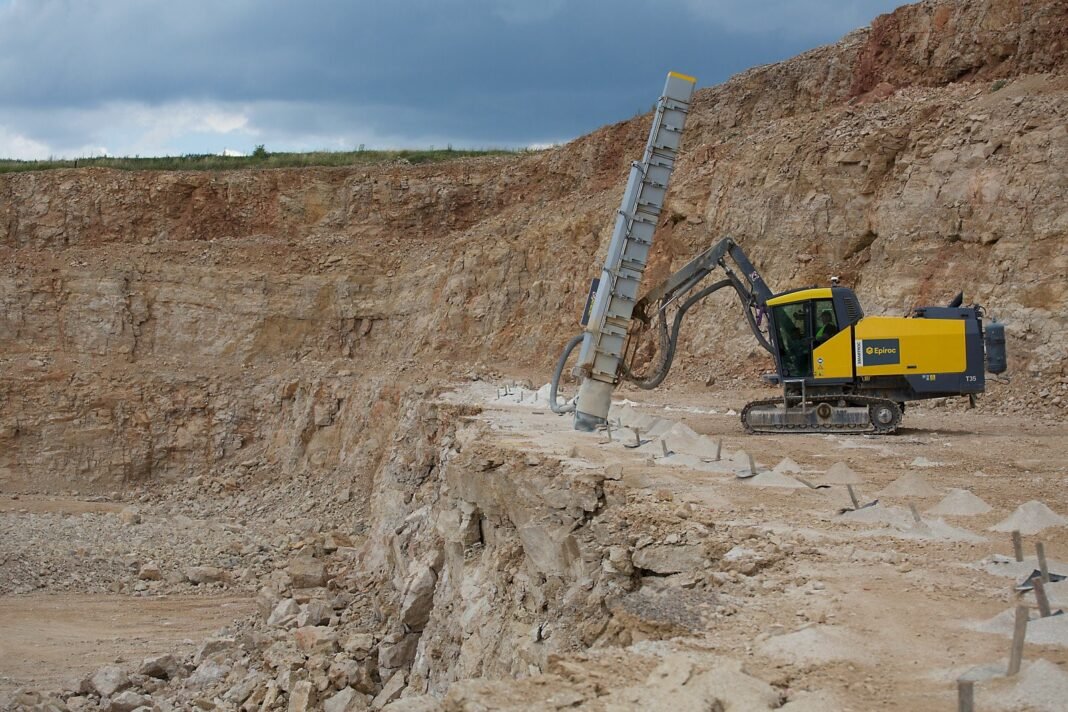
The customer has ordered a fleet of Pit Viper 275 E blasthole drill rigs — cable-electric machines that will be operated fully autonomously, boosting safety and productivity while producing zero exhaust emissions.
Epiroc has not disclosed the identity of the customer or the precise location in Africa where the rigs will be deployed.
Delivery is scheduled to begin shortly and is expected to be completed by the end of 2027.
A Machine Built for the Pit
The Pit Viper 275 E is no ordinary drill rig. It can drill single-pass holes reaching depths of up to 59.4 metres and diameters between 171mm and 270mm.
The electric-powered design offers a sharply reduced carbon footprint, while its advanced automation features allow the machine to autonomously position itself at the drilling site and execute the drilling pattern with precision — operating continuously without breaks, and without an operator on board.
The rig’s autonomous capability is built on more than a decade of real-world field experience.
Since Epiroc first trialled autonomous operations on Pit Viper rigs at an iron ore mine in Australia’s Pilbara region, the technology has spread to dozens of open-pit operations worldwide, spanning copper, gold, platinum, and phosphate mining.
The cumulative performance data from that decade of autonomous operation is striking. Depth accuracy of drilled holes has increased by an average of 85%, leading to more than 8 million wasted overdrill metres being avoided.
Spatial accuracy has improved by an average of 60%, and average utilisation of a Pit Viper rig in autonomous mode runs 17% higher than in manual mode.
Across the fleet, approximately 85 million litres of fuel have been saved, with CO₂ emissions reduced by around 225,000 tonnes.
Leadership Signals Strategic Importance
Helena Hedblom, Epiroc’s President and CEO, framed the Africa deal within the company’s broader transformation strategy.
“Epiroc is on the forefront of mining automation and electrification, and this major order is another significant step forward in our journey to support customers to operate in the safest, most productive and most climate-friendly manner possible,” she said.
Hedblom has been vocal about the momentum building across the sector. Demand for Epiroc’s products remained strong throughout 2025, driven primarily by mining customers — who account for 79% of total orders — buoyed by higher mineral prices, mainly for gold and copper.
The Africa deal sits within a broader wave of electric and autonomous orders. Epiroc’s most significant contract of 2025 was its largest to date: a five-year agreement worth approximately SEK 2.2 billion with Fortescue in Australia, under which the company will deliver a fleet of around 50 fully autonomous and electric surface drill rigs to be operated remotely from Fortescue’s Integrated Operations Centre in Perth — more than 1,500 kilometres from the mines themselves.
Africa’s Moment in the Technology Shift
The Africa order arrives at a pivotal moment for the continent’s mining industry. The Africa mining equipment market is valued at approximately USD 3.12 billion in 2025 and is forecast to reach USD 3.84 billion by 2030, driven by sustained demand for critical minerals, large-scale surface mining expansions, and accelerating adoption of automated and battery-electric fleets.
Industry analysts had anticipated exactly this kind of development.
Forecasters predicted that 2026 would see autonomous technology spread beyond its traditional strongholds in Australia into major copper and gold operations across Africa and the Americas — becoming significantly more mainstream rather than exceptional.
The share of autonomous, autonomous-ready, or tele-remote mining equipment globally has already climbed from under 1% in 2020 to over 4% today.
African mining leaders have been pushing this agenda from within. At Mining Indaba 2026, industry dialogue shifted away from aspirational targets toward a more urgent question of execution, with electrification, automation, and digitalisation increasingly framed as operational necessities rather than parallel innovation projects.
Safety, Productivity, and the Zero-Emission Imperative
The appeal of fully autonomous rigs in African surface mines is not simply technological novelty — it is strategic.
Open-pit blasting operations are among the most hazardous environments in the industry, and removing workers from the pit while maintaining continuous round-the-clock drilling addresses both safety and productivity imperatives simultaneously.
Autonomous drills take human error entirely out of the equation. The control system will not deviate from how it was trained to perform.
While even the most skilled driller varies in performance over a shift due to fatigue, distraction, or simple error, autonomous systems drill with consistent precision — replicating the same quality of hole, shift after shift, regardless of who is monitoring the operation.
On the environmental side, cable-electric drilling eliminates on-site exhaust emissions entirely, reducing diesel dependence and shielding operations from fuel price volatility.
For African mines increasingly scrutinised by international investors and ESG frameworks, the zero-exhaust Pit Viper 275 E speaks directly to those concerns — allowing mines to pursue production growth without a corresponding rise in their carbon footprint.
A Global Leader Deepening Its African Footprint
Epiroc employs nearly 19,000 people and supports customers across around 150 countries.
The company has been steadily expanding its autonomous surface drilling portfolio across multiple continents, and the Africa order represents a meaningful step onto a continent where large-scale autonomous deployments have historically lagged behind Australia, Canada, and Chile.
Industry projections suggest that trajectory is about to change. Experts forecast that by 2030, fully autonomous mining operations will be active in at least five African countries, with the technology spreading more widely as costs fall and capabilities improve.
For now, the identity of the African customer behind this SEK 380 million deal remains undisclosed.
What is clear is that somewhere on the continent, a fleet of driverless, emissions-free drill rigs will soon be boring into rock, repositioning autonomously, and drilling with a consistency no human operator can sustain around the clock — a quiet but consequential milestone in Africa’s industrial transformation.
Also Read
How Komatsu Is Building the Future of Autonomous Mining in Africa in 2026
Can the Cat 707 Wide Body Truck Reduce Cost Per Ton in African Mining?

- Epiroc Secures Major Order for Autonomous Electric Mining Rigs in Africa - April 1, 2026
- Best Shower Heads for Salty Water:The Complete 2026 Buyer’s Guide to Protecting Your Skin, Hair & Plumbing - April 1, 2026
- Top 7 Must-Have Bathroom Accessories for a Stylish and Functional Space - March 31, 2026
