
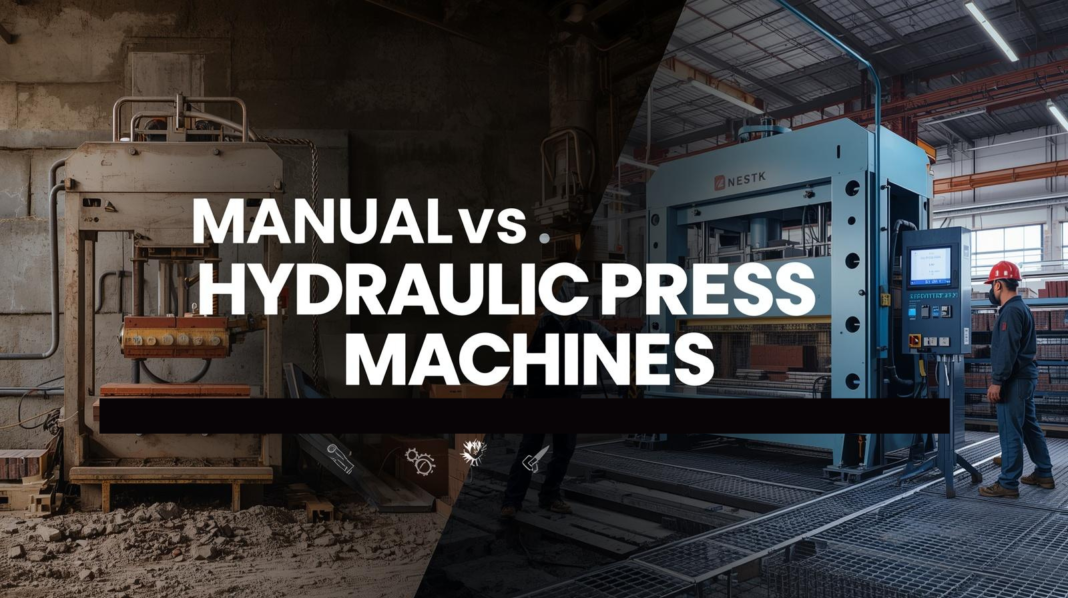
April 2026: Walk through any active construction market in Africa — Lagos, Nairobi, Accra, Lusaka, Kampala — and you will find block yards at every scale, from a single worker operating a hand-lever press in a roadside compound to a semi-automated production yard turning out thousands of units a day.
Two machine types dominate this market: the manual press and the hydraulic press. Both produce concrete blocks and interlocking bricks.
Both have passionate advocates. And choosing the wrong one for your operation is an expensive mistake that takes years to correct.
This article lays out an honest, evidence-based comparison so you can make the right call for your specific situation.
First, Understand What You Are Comparing
The terms ‘manual’ and ‘hydraulic’ are used loosely in the African brick making market, and the confusion they generate costs operators money.
Before evaluating which is better, it is worth being precise about what each machine type actually is.
The Manual Press Machine
A manual press brick machine — sometimes called a hand press, lever press, or manual block moulder — compacts the concrete or soil-cement mix through human mechanical force applied via a lever, handle, or ram system.
The operator physically loads raw material into the mould, then applies downward pressure to compact and form the block. The block is then ejected — again, usually manually — and the cycle repeats.
The defining characteristic is that human effort is the primary compression force. There is no motor, no hydraulic pump, no PLC control system.
The machine is a tool that amplifies human strength through leverage. Entry-level manual interlocking brick machines — such as the LT2-40 and comparable models sold widely across East and West Africa — are available for as little as $900 to $1,500.
These machines require no electricity, no diesel fuel for power generation, and no technical maintenance beyond basic lubrication and bolt-tightening.
The Hydraulic Press Machine
A hydraulic press brick machine uses a pressurised fluid system — typically hydraulic oil driven by an electric motor or diesel engine — to generate the compressive force that forms the brick.
The hydraulic cylinder delivers controlled, consistent pressure to the mould on every cycle. Depending on the automation level, this process may be semi-automated (the operator controls the press cycle via buttons or levers) or fully automated via a PLC control system.
Hydraulic press machines span an enormous range. At the compact end, small mobile hydraulic machines such as the Hydraform M7MI — widely used across East and Southern Africa — run on diesel engines producing hydraulic pressures of around 16 MPa and output approximately 300 blocks per hour.
At the commercial scale, large stationary hydraulic block machines deliver pressures from 20 MPa to 60 MPa or higher, producing upward of 10,000 to 30,000 blocks per eight-hour shift.
Prices range from roughly $2,000 to $3,500 for small mobile hydraulic machines, to $20,000 and beyond for mid-scale automatic hydraulic production lines.
The category labels ‘manual’ and ‘hydraulic’ do not define a single machine — they define a compression mechanism.
A small hydraulic machine may cost only marginally more than a large manual press but deliver fundamentally different output quality and volume. Understand the mechanism before comparing the price tag.
Head-to-Head: Six Dimensions That Matter
- Production Output and Speed
This is the most immediately apparent difference between the two machine types, and the gap is significant.
Manual press machines, operated by a single crew, typically produce between 1,000 and 2,000 standard bricks or blocks per eight-hour day. At the upper end of this range, the operator and mixing crew need to maintain a punishing pace throughout the shift.
Fatigue is a genuine constraint: as the shift progresses and workers tire, output rates typically fall — and so does the consistency of compaction force applied to each mould.
Semi-automatic and hydraulic machines occupy a different tier entirely. A well-operated semi-automatic machine with a hydraulic pressing system can produce 3,000 to 6,000 bricks per day.
The Hydraform M7MI — arguably the most widely deployed brick machine in Sub-Saharan Africa — achieves 275 to 320 blocks per hour with a crew of approximately nine, delivering around 2,200 blocks per eight-hour day.
Its twin-mould automated variant pushes output to 700 to 750 blocks per hour, or roughly 6,000 per day.
Large-scale fully automatic hydraulic machines, such as the QT10-15, produce upward of 14,000 hollow blocks per day. The QT4-18, a mid-scale option popular in Nigeria, delivers up to 50,000 standard bricks in a day — output that no manual operation can approach.
The production volume question is not abstract. It directly determines what markets you can serve.
A contractor ordering 20,000 blocks for a residential project needs them delivered reliably within a week.
A manual machine producing 1,500 bricks per day takes thirteen days for that order — assuming no stoppages, no curing delays, and no public holidays. A hydraulic machine at 5,000 per day fills that same order in four days, with capacity to take on other orders simultaneously.
Verdict: Hydraulic press machines win on output, and it is not a close contest. For any operation targeting contractors, developers, or government projects requiring consistent bulk supply, manual machine output is a structural constraint on growth.
- Block Quality and Compressive Strength
Compression force is the dominant factor in block density and compressive strength — and hydraulic systems apply it in a way that human mechanics simply cannot replicate consistently.
A hydraulic cylinder delivers the same programmed pressure to every mould cycle, regardless of operator fatigue, shift time, or the variability of the raw material batch. The result is uniform block density, consistent dimensions, and predictable strength characteristics that meet or exceed specification.
Hydraulic press machines that incorporate a step-by-step pressurisation and multiple exhaust cycle — in which air is expelled progressively during compression — produce especially dense, crack-resistant bricks.
The process eliminates internal voids that weaken blocks and allows higher compressive strengths to be achieved without increasing cement content.
For interlocking clay and soil-cement bricks, hydraulic pressures of 10 to 60 MPa used in commercial machines can produce unstabilised compressed earth blocks reaching 5 MPa compressive strength, rising to 10 MPa or higher with 5% cement addition — well above requirements for residential construction.
Manual machines produce blocks through variable human compaction. A skilled, rested operator working carefully with a quality mix can produce perfectly adequate blocks for residential-grade construction.
The problem is variability. Between the first block of the morning and the last block of the afternoon, the compaction force applied by a tired worker may be significantly reduced.
That variability translates to inconsistent web thickness, variable density, and unpredictable compressive strength within the same batch. For structural applications — multi-storey buildings, load-bearing walls, foundation courses — this variability is a quality and safety liability.
Manual machines are not incapable of producing good-quality blocks. They are incapable of producing consistent blocks at scale. That distinction matters as much in reputation terms as it does in structural terms.
Verdict: Hydraulic press machines produce consistently stronger, denser, more dimensionally accurate blocks. For structural applications and for operators whose reputation depends on product uniformity, the hydraulic mechanism has a clear and technically grounded advantage.
- Capital Cost and Accessibility
This is the most compelling argument for manual machines, and it should be taken seriously. The African brick making market is populated primarily by small-scale entrepreneurs and first-time operators working with limited starting capital.
For these operators, the price difference between a manual and a hydraulic machine is not a marginal consideration — it can determine whether the business launches at all.
At the absolute entry level, a basic manual hand press for interlocking bricks (such as the LT2-40) is available for $900 to $1,000.
Locally fabricated manual block moulding machines in Nigeria are sold for as little as NGN 250,000 to NGN 600,000 — under $500 at current exchange rates — though quality and output consistency vary considerably.
A basic manual concrete block moulder in the South African market starts from approximately ZAR 15,000.
Entry-level hydraulic machines begin at roughly $2,000 to $3,500 for small mobile soil-cement models. Mid-range semi-automatic hydraulic machines with meaningful production capacity — the QT4-15, the Hydraform M7MI, and equivalent Turkish and Chinese models — run from $10,000 to $25,000.
Full-scale automatic hydraulic block lines begin at $30,000 and scale upward significantly. For operators working with personal savings or informal family loans, this price difference is the primary, often decisive, factor.
However, the capital cost comparison should not end at the purchase price. A manual machine producing 1,500 bricks per day employs the same number of people — or more — as a semi-automatic hydraulic machine producing 4,000 per day.
The labour cost per brick produced is structurally higher on a manual machine, and that cost compounds over the life of the business.
An honest total cost of ownership calculation — factoring in output volume, labour costs per unit, downtime rates, and maintenance — often shows a shorter return-on-investment period for hydraulic machines than the raw price gap suggests.
Verdict: Manual machines win on entry price. But entry price is not the same as total cost.
For operators who can access even modest financing — microfinance, equipment lease, cooperative lending — the productivity advantage of a hydraulic machine typically justifies the higher upfront cost within the first year of operation.
- Power and Infrastructure Requirements
This dimension is where manual machines have a genuine, context-specific advantage over hydraulic press systems — and it is an advantage that is acutely relevant to the African market.
A manual press machine requires no electricity, no diesel fuel, and no infrastructure beyond a flat surface and a water source.
It can be set up in a rural community without grid connection, powered entirely by human labour. This is not a trivial benefit in a continent where, according to the African Development Bank, only about 43% of Sub-Saharan Africa’s rural population has access to reliable electricity.
In markets where load shedding is a daily commercial reality — South Africa is the obvious example, but intermittent supply is a nationwide challenge across Nigeria, Ghana, and Kenya — a machine that keeps running regardless of grid status has operational value that does not appear in a specification sheet.
Hydraulic machines require power — either grid electricity (typically three-phase for larger models) or a diesel engine.
Both have running costs that compound over time. Diesel-powered hydraulic machines, such as the Hydraform M7MI and numerous Chinese-manufactured mobile models, address the grid dependency issue at the cost of fuel consumption and engine maintenance.
For operators in off-grid or unreliable-grid environments who want hydraulic production quality, diesel-powered hydraulic machines represent the practical middle ground.
They deliver hydraulic pressing force without dependence on municipal electricity, at the cost of an ongoing diesel fuel budget and engine service requirements.
Fully automatic hydraulic machines with PLC control systems additionally require a stable three-phase electrical supply and, in many cases, a technically qualified electrician for maintenance.
These infrastructure requirements rule them out for peri-urban and rural block yards that are not connected to reliable three-phase supply.
Verdict: Manual machines hold a genuine infrastructure advantage in off-grid, rural, and load-shedding-affected environments. Diesel-powered hydraulic machines neutralise this advantage at a fuel cost. Grid-dependent hydraulic systems are constrained by power supply quality. Match your machine choice to the infrastructure reality of your site.
- Maintenance, Durability, and Running Costs
Manual machines have almost no maintenance complexity. The absence of hydraulic systems, electric motors, PLC controllers, and pneumatic components means there are very few failure modes.
Typical maintenance requirements are lubrication of pivot points, tightening of bolts, and occasional replacement of worn mould plates. Most minor repairs can be carried out by any mechanic with basic hand tools.
Spare parts are generic steel components available locally. Downtime from mechanical failure is rare and, when it occurs, is usually short and inexpensive to remedy.
Hydraulic machines are more complex. The hydraulic system itself — pump, cylinder, valves, seals, and oil — requires periodic inspection, fluid level monitoring, and seal replacement to maintain performance.
Oil contamination or seal failure can cause significant output degradation and, if undetected, can damage the cylinder or pump.
PLC-controlled automatic machines additionally require an operator familiar with the control system and, for serious faults, a qualified technician.
Research from machine suppliers consistently recommends daily hydraulic fluid checks, weekly inspection of hoses and fittings, and comprehensive annual servicing including hydraulic system flushes and electrical system testing.
The operational life of well-maintained hydraulic machines from reputable manufacturers — Hydraform (South Africa), BESS and VESS (Turkey), Lontto and HF Machinery (China) — is typically 10 to 15 years or more. However, this longevity depends entirely on maintenance quality.
A hydraulic machine that is poorly maintained degrades faster and more expensively than a manual machine that is neglected, because the failure modes are more complex and the repair costs are higher.
Verdict: Manual machines are simpler to maintain and more resilient to neglect. Hydraulic machines require disciplined maintenance but deliver longer productive life when properly serviced.
In markets where qualified hydraulic technicians are scarce, the simpler maintenance profile of a manual machine is a practical advantage.
- Product Range and Versatility
Both manual and hydraulic machines can produce multiple block types through mould changes — hollow blocks, solid blocks, interlocking bricks, paving blocks, and kerbstones are achievable on both platforms.
However, hydraulic machines unlock product categories that manual presses cannot reach effectively.
Compressed Earth Blocks (CEBs) and Interlocking Stabilised Soil Blocks (ISSBs) — products that are gaining significant traction across East, West, and Central Africa as low-cost, local-materials alternatives to cement-intensive blocks — are particularly well-suited to hydraulic production.
The high compression pressures achievable with hydraulic systems (10 to 200 tonnes of press force on commercial machines) produce soil-cement interlocking bricks that, when stabilised with as little as 5% cement content, achieve compressive strengths of 10 MPa or above.
These bricks can be dry-stacked without mortar for up to 70% of the structure — eliminating a major material and labour cost from the construction process.
Manual presses can produce CEB bricks, and the original CINVA-Ram hand press was specifically designed for this purpose.
However, the compressive force achievable by human lever operation is significantly lower than hydraulic pressing force, producing less dense blocks with lower compressive strength.
For stabilised soil bricks destined for load-bearing walls in permanent structures, the strength difference is meaningful. For rural community self-build projects where a simple shelter with adequate durability is the goal, a manual CEB press may be perfectly sufficient.
For standard hollow and solid concrete blocks using cement-sand mixes — still the dominant product category across most of the continent — both machine types are technically capable.
The difference lies in output quality consistency and production volume, as discussed above.
Verdict: Hydraulic machines offer greater versatility and unlock higher-quality product categories, particularly for compressed earth and soil-cement interlocking bricks.
Manual machines remain capable for standard block production but are limited in the strength levels achievable for premium products.
The honest answer is that neither machine type is universally better.
The right machine depends entirely on the operator’s context — and the worst outcome is choosing based on price alone without accounting for output requirements, market position, infrastructure availability, and growth trajectory.
Choose a Manual Press Machine if:
- You are entering the brick making business with limited capital and cannot access equipment financing
- Your target market is self-build residential customers, community housing projects, or small local contractors with modest volume requirements
- Your site is off-grid, in a rural area, or in a market with frequent power interruptions and no reliable diesel supply
- You want to learn the business before committing to larger capital expenditure — manual machines are a legitimate training ground for understanding mix ratios, curing, and block quality before scaling
- You are producing compressed earth interlocking bricks for low-cost rural housing where strength requirements are modest and local labour is the primary input
Choose a Hydraulic Press Machine if:
- Your target market includes contractors, developers, affordable housing projects, or government procurement — customers who require consistent quality and volume supply
- You can access financing for a semi-automatic or mid-scale machine and your projected revenue can service the loan within 18 to 24 months
- Your site has reliable electricity (single or three-phase) or you can budget for a diesel-powered hydraulic machine
- You intend to produce premium interlocking soil-cement bricks or compressed earth blocks for commercial sale — the compressive strength advantage of hydraulic pressing is commercially significant in this segment
- You are already operating a manual machine and have hit the output ceiling — scaling to hydraulic is the natural progression for an established operator ready to move up-market
Many successful African block yard operators follow the same arc: start manual to learn the business and build initial customer relationships, then upgrade to hydraulic within 12 to 24 months as cash flow and credit access allow. The manual machine is not a dead end — it is a starting point with a clear upgrade path.
A Note on the African Context
The global brick press machine market, valued at $1.5 billion in 2025 and growing at 7% annually, is overwhelmingly driven by demand from Africa, Asia, and Latin America.
In Africa specifically, the dominant machine suppliers — Turkey’s Hydraform and VESS, China’s Lontto, BESS, and HF Machinery, South Africa’s Hydraform — have adapted their product lines significantly to the operational realities of African markets.
That adaptation includes the proliferation of diesel-powered hydraulic models that address grid unreliability without sacrificing pressing performance, machines engineered for simpler maintenance in markets where qualified hydraulic technicians are scarce, smaller footprint designs suited to compact urban and peri-urban sites, and lower capital cost entry-level hydraulic models that bring the performance advantages of hydraulic pressing within reach of smaller operators.
The Hydraform M7MI — a diesel hydraulic mobile machine producing SABS-approved interlocking blocks — has become a reference product across Sub-Saharan Africa precisely because it resolves the grid dependency problem while delivering commercial-grade output quality.
The global hydraulic brick press machine market in the Middle East and Africa segment is projected to continue growing through 2033 as urbanisation accelerates and housing programme procurement shifts toward mechanised production.
The trend is clear: the market is moving toward hydraulic pressing. Manual machines will remain relevant at the community and entry-level segment, but the commercial brick making business in Africa is consolidating around hydraulic production.
For the operator choosing a machine today, the question is not which technology is better in the abstract. The question is: where in that market do you want to be in three years, and which machine gets you there from where you are starting now?
The Bottom Line
Manual press machines are accessible, durable, power-independent, and good enough for modest residential brick production.
Hydraulic press machines are faster, more consistent, stronger, and far better positioned for commercial-scale supply to contractors and developers. Both have a place in the African market. Neither is the right answer for every operator.
Buy the machine that matches your market, not the one with the lowest sticker price. If a manual machine genuinely serves your customer base and your infrastructure reality today, buy it and run it profitably while you save toward the hydraulic upgrade.
If your market is already demanding more volume and more quality than a manual machine can deliver, find the financing and buy the hydraulic press now — the cost of under-investment in output capacity is slower growth, lost contracts, and a business that plateaus before it finds its ceiling.
Africa is building. The market for bricks will not shrink. The question is which tier of that market you want to serve, and which machine gets you there.
Also Read
Top 7 Mistakes to Avoid in Concrete Block Manufacturing
Starting a Block Making Business in Africa: What You Need to Know

- Manual vs Hydraulic Press Machine for Brick Making:Which One Is Better? - April 13, 2026
- Oil Prices Surge Above $100 as US Plans Blockade on Strait of Hormuz - April 13, 2026
- Top 7 Mistakes to Avoid in Concrete Block Manufacturing - April 13, 2026
