

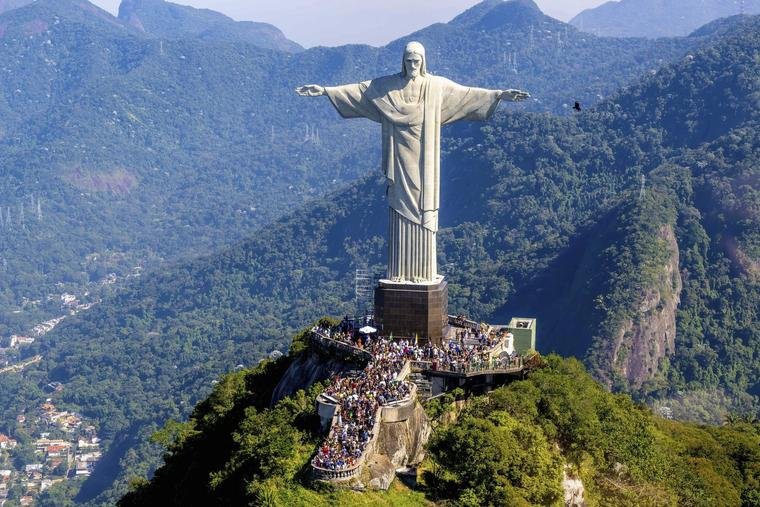
The idea of placing a giant statue atop Corcovado — a granite peak jutting 710 metres above Rio de Janeiro — had floated around Brazilian Catholic circles since the late 19th century.
But it was only in 1921, as Brazil prepared to celebrate a century of independence from Portugal, that the project gained real urgency.
The Catholic Circle of Rio launched a national campaign called “Monument Week,” collecting signatures and donations from the faithful. The goal: a statue visible to the entire city, embodying both faith and national identity.
The design competition drew several proposals. Engineer Heitor da Silva Costa won the commission and initially sketched a Christ figure holding a cross and a globe — a pedestalled, frontally rigid form.
Over time, the design evolved dramatically. The outstretched arms were introduced as a gesture of universal welcome, far more expressive and structurally demanding than anything the original proposal had imagined.
“The arms were not just symbolic — they transformed a simple monument into a structural puzzle that no team in Brazil had ever attempted at this scale.”
Construction timeline
The engineering team behind the icon
The statue’s construction was fundamentally a transatlantic collaboration, with distinct contributions from Brazil and France.
Heitor da Silva Costa handled the structural conception and oversaw construction on site. His compatriot engineer Pedro Viana da Silva worked closely with him on the reinforced concrete frame.
The sculptural work, however, was entrusted to French-Romanian artist Paul Landowski, who worked from clay models in his Boulogne-Billancourt studio near Paris.
Landowski’s genius lay in deconstructing the figure into modular components — segments of the face, hands, and torso — that could be sculpted to perfection in a studio, shipped across the Atlantic, and assembled piece by piece on a windswept mountain summit.
The head and hands of the statue — the most expressive and technically demanding parts — were developed by Landowski in close consultation with Brazilian engineer Heitor da Silva Costa’s sketches.
Photographs of the evolving clay maquettes traveled back and forth between Rio and Paris by post for years before the full-scale work commenced.
Reinforced concrete in the sky
The structural skeleton of Christ the Redeemer is a reinforced concrete frame — a technology that was still relatively new and untested at this scale in the 1920s.
The inner armature acts like a steel-and-concrete tree: a central vertical column rising through the body, with cantilevered horizontal arms branching outward.
The arms presented the most significant engineering challenge. Each arm extends 14 metres from the body and had to bear not only its own considerable weight — several tons of concrete and stone cladding — but also resist the dynamic loads imposed by wind gusts that regularly exceed 80 km/h at the summit.
Engineers embedded a network of steel rods within the concrete, creating a composite structure with enough tensile strength to handle these lateral forces without cracking or deflecting.
The pedestal itself, standing 8 metres tall, was designed as a chapel. It anchors the statue to the mountain’s granite base through a deep foundation system that binds the structure to the rock, preventing any sliding under the combination of the statue’s weight and wind-induced lateral forces.
“Each horizontal arm acts as a giant cantilever — concrete strong in compression, steel reinforcement absorbing tension — a principle borrowed from bridge engineering and applied to sacred art.”
The material choices: why soapstone?
The exterior cladding of Christ the Redeemer is not painted concrete or carved granite — it is soapstone, known in Portuguese as pedra-sabão.
The choice was deliberate and ingenious. Soapstone is a metamorphic rock with exceptional properties: it is soft enough to carve and shape into precise mosaic tiles, yet highly resistant to weathering, moisture, and temperature extremes — critical in Rio’s humid subtropical climate.
Landowski’s studio produced approximately 6 million individual soapstone triangular tiles. Each was hand-crafted to a specific curvature corresponding to the surface of the statue at its designated location.
The tiles were numbered, packed into crates, and shipped to Brazil, where local workers assembled them like an enormous three-dimensional puzzle — a process that took several years of painstaking labor on scaffolding above the clouds.
The pale gray-white tone of soapstone gives the statue its distinctive luminous quality, appearing almost to glow in Rio’s sharp tropical light.
It also ages gracefully, developing a natural patina rather than the staining and spalling that would have afflicted painted or unprotected concrete surfaces.
The vertical challenge: getting materials to the summit
Building at 710 metres elevation in the early 20th century posed a logistical problem almost as formidable as the engineering.
A narrow-gauge railway — the Corcovado Rack Railway, originally built in 1884 — was the only reliable route to the summit.
Workers adapted it to carry construction materials: steel rods, cement sacks, timber formwork, and crate after crate of soapstone tiles were winched up the steep mountain incline.
When the railway was insufficient or unavailable, workers carried loads manually up narrow forest paths in the Tijuca rainforest.
Hundreds of workers — many of them local to Rio, many others migrant laborers — contributed to the construction over its nine active years.
Their names are largely unrecorded, a silence that historical reassessments of the project have increasingly sought to address.
Lightning, renovation, and resilience
Since its inauguration in 1931, Christ the Redeemer has withstood nearly a century of tropical weather, regular lightning strikes — the statue is one of the highest points in the entire region — and the inevitable wear of time.
The soapstone tiles have been a recurring maintenance concern; periodic restoration campaigns, notably in 2010 and 2019, have replaced damaged tiles and reinforced the underlying structure.
In 2010, a severe electrical storm cracked one of the fingers of the right hand and caused damage to the head.
Restoration crews scaled the statue using the same fundamental access strategies as the original builders — scaffolding, rope systems, and meticulous manual work — to repair the damage with freshly carved soapstone replacements sourced from Ouro Preto, in the Brazilian state of Minas Gerais, the same source as the original tiles.
Legacy in concrete and stone
Christ the Redeemer was declared one of the New Seven Wonders of the World in 2007, a title voted on by over 100 million people globally. But its engineering legacy predates that recognition by decades.
It stands as an early proof-of-concept for large-scale reinforced concrete sculpture, a forerunner of techniques later used in monumental statues across the world from the United States to Southeast Asia.
What makes the statue remarkable from an engineering perspective is not any single innovation but the synthesis of disciplines: structural engineering, sculptural craft, material science, and high-altitude logistics all converged on a granite mountaintop in the 1920s — with hand tools, a narrow-gauge railway, and crates of numbered stone arriving by ship from Paris.
The result has endured for nearly a century with the mountain, the city, and the sky as its only witnesses to that audacity.
Also Read
10 Major Highway and Bridge Projects Transforming America in 2026

- From Operator to Algorithm: Bedrock Puts Autonomous Excavators to Work on Live Construction Sites - September 7, 2026
- Built For The Rough Stuff: Inside Titan’s new ForestEDGE™ Tyre Line - September 4, 2026
- South Africa Has R395 Billion in Infrastructure Projects — But Can the Industry Deliver Them? - August 26, 2026
