

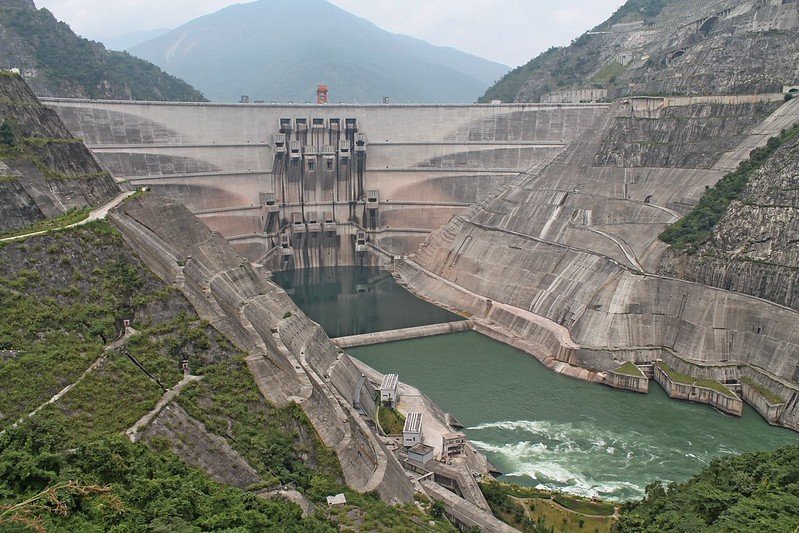
On a grey July morning in 2025, Chinese Premier Li Qiang stood in the remote Tibetan city of Nyingchi and declared that ground had been broken on what he called a “project of the century.” He was not exaggerating.
The Medog Hydropower Station — a cascade of five dams carved into one of the deepest river canyons on Earth — is, by almost any measure, the largest and most expensive infrastructure project in the history of human civilization.
At an estimated cost exceeding 1.2 trillion yuan, or roughly $165 billion, it is more than four times costlier than the Three Gorges Dam it was designed to dwarf.
When complete in 2033, it will generate 300 billion kilowatt-hours of electricity every year — nearly triple Three Gorges — enough to power the entire United Kingdom from a single Himalayan gorge.
But behind the spectacle of that groundbreaking ceremony — and the silence that has surrounded the project inside China ever since — lies a story far more complicated than Beijing’s official narrative of clean energy and frontier development.
The Medog dam sits where tectonic plates collide, where sacred Tibetan rivers begin their long journey to the sea, and where the water security of 1.8 billion people downstream in India and Bangladesh intersects with China’s ambitions to dominate the next industrial revolution.
Understanding what is being built here — and why, and at what cost — is one of the defining infrastructure questions of our time.
“Any worldly event that involves the movement of mass affects the Earth’s rotation.” — NASA Geophysicist Dr. Benjamin Fong Chao
The Great Bend: Nature’s Gift to an Engineer
The site itself is unlike any other dam location on the planet. The Yarlung Tsangpo River, rising on the Tibetan Plateau near Mount Kailash, carves a 2,900-kilometre arc across southern Tibet before arriving at the Eastern Himalayas — and then something extraordinary happens.
The river performs an abrupt U-turn around the peaks of Gyala Peri and Namcha Barwa, plunging more than 2,000 metres in elevation over just 50 kilometres, forming what geologists call the Great Bend.
This is the world’s deepest land canyon — three times deeper and 37 miles longer than the Grand Canyon. For a hydropower engineer, it represents an almost unimaginable concentration of gravitational potential energy.
China’s design exploits this geography in a way that sets the Medog project apart from conventional dam construction.
Rather than building a single colossal wall to impound a reservoir — as Three Gorges did, flooding valleys, relocating millions, and burying cities — Medog will divert a portion of the river flow through four 20-kilometre tunnels bored directly through the Namcha Barwa massif.
The water drops through the mountain, spins the turbines of five cascade power stations on the far side, and rejoins the river downstream.
There is no colossal wall. There is no giant reservoir. What there is, instead, is arguably the most audacious tunnel engineering project ever attempted.
The engineering precedent already exists within China’s own borders. The Jinping II Hydropower Station on the Yalong River uses an almost identical concept — four parallel tunnels, each 17 kilometres long, running through a near-vertical mountain range.
Jinping II has operated stably for six years. At Medog, the tunnels will be 20 kilometres, the gradient steeper, and the geology more unpredictable.
Chinese engineers have also developed the tunnel boring machines for this task domestically, a capability once monopolised by German manufacturers.
This combination of experience and domestic industrial capacity is, in large part, why a project that was merely theoretical for decades finally became buildable in 2025.
Four Drivers: Why China Is Building This Now
The Medog project did not emerge from nowhere. It was formally included in China’s 14th Five-Year Plan (2021–2025) and approved by the State Council on Christmas Day 2024 — a date that, whether by coincidence or design, attracted minimal international media attention.
Four interlocking strategic imperatives explain its timing and scale.
The first is energy security. China is the world’s largest energy consumer and has committed to peaking carbon emissions by 2030 and reaching carbon neutrality by 2060. Hydropower, unlike wind and solar, offers something rare and politically valuable: stable, dispatchable baseload power.
It generates electricity whether or not the sun is shining or the wind is blowing, which makes it the backbone of any grid that must be both clean and reliable.
Three Gorges already supplies roughly 3 per cent of China’s national electricity consumption annually, powering an estimated 70 to 80 million homes. Medog would triple that contribution from a single project.
The second driver is AI and digital infrastructure. By 2025, China’s computing infrastructure alone was projected to consume around 360 billion kilowatt-hours annually — and demand is rising sharply as the country expands AI training, cloud computing, and advanced manufacturing.
Data centres and semiconductor fabs need continuous, uninterrupted power that cannot be sourced from intermittent renewables alone.
The 300 billion kWh annual output of Medog would, at a stroke, provide something approaching a dedicated power source for China’s digital economy ambitions — at zero carbon emissions at the point of generation.
The third is frontier development and political integration. Beijing has long used large infrastructure projects as instruments of political consolidation in Tibet.
Roads, railways, pipelines, and military installations have, over decades, bound the region more tightly to the Chinese state. Medog is located in one of the most remote corners of Tibet, a county that only opened to outside visitors in the 1990s and that remains difficult to access.
Anchoring that frontier to the national grid and creating durable economic activity — construction employment, transmission infrastructure, industrial linkages — is a classic Beijing playbook, applied at extraordinary scale.
The fourth driver is geopolitical positioning. The dam sits approximately 100 to 200 kilometres from the disputed border between Tibet and Arunachal Pradesh, a territory that India administers but China claims as “South Tibet.”
Control of the upper Yarlung Tsangpo gives Beijing, at minimum, hydrological influence over rivers that sustain India’s northeastern states and Bangladesh’s delta region. Whether or not China ever uses that influence as an explicit lever, the mere fact of upstream control is a strategic asset in a century when freshwater scarcity will increasingly drive regional tensions.
“Unlike Three Gorges, this mega-project has drawn almost no public discussion inside China. Outside China, it has fuelled alarm from New Delhi to Dhaka.”
Downstream Alarm: India, Bangladesh, and the Water Wars Question
India’s reaction to the Medog announcement was immediate and pointed. New Delhi has formally conveyed concerns to Beijing about downstream water security.
Assam Chief Minister Himanta Biswa Sarma, whose state sits directly in the river’s path after it enters India, has said the government will “protect its interests” — while also noting, somewhat counterintuitively, that reduced upstream flow might actually help mitigate Assam’s chronic annual flooding.
India has also threatened to accelerate its own dam construction on the Indian reaches of the Brahmaputra, triggering warnings from Bangladesh that Indian dams in turn could reduce the Jamuna’s flow further downstream.
Bangladesh, with far less leverage than India, has taken a more diplomatic tack. In February 2025, Bangladeshi officials formally requested hydrological data from Beijing, citing potential impacts on river flow, agriculture, and livelihoods in the densely populated delta.
Malik Fida Khan, head of the Centre for Environmental and Geographic Information Services in Dhaka, warned that the Brahmaputra provides roughly 70 per cent of Bangladesh’s dry-season river flow.
Any sustained reduction — whether through diversion, storage, or altered seasonal timing — could threaten drinking water supply, irrigation, and the ecological health of the world’s largest river delta.
China’s official position is that Medog is a run-of-the-river project — meaning it diverts water to generate power and returns it to the channel downstream, without net reduction in flow. Chinese engineers argue that because the design uses elevation drop rather than large-scale storage, it will not significantly impound water or alter the river’s seasonal rhythms.
Hydrologists examining the design broadly agree that the absence of a large reservoir limits the project’s ability to weaponise water flows in the way that conventional dams can.
But they add a critical caveat: the absence of independent environmental impact assessments, and Beijing’s consistent refusal to share real-time hydrological data with downstream nations, means that these assurances cannot currently be verified.
India has proposed strengthening the Expert Level Mechanism — a bilateral water-sharing consultative body — to include real-time data sharing and joint assessments.
China has not agreed. That gap between reassuring words and verifiable data lies at the heart of why downstream alarm has not abated despite Beijing’s repeated assurances of no adverse impact.
Seismic Risk and Ecological Fragility
Beyond water politics, the engineering risk profile of Medog is genuinely unusual. The Great Bend sits at the collision boundary of the Indian and Eurasian tectonic plates — the same geological drama that built the Himalayas and that continues to generate some of the most powerful earthquakes on Earth.
The 1950 Assam-Tibet earthquake, which struck near this region, registered 8.6 on the Richter scale — among the largest recorded in the twentieth century.
In January 2025, a 6.8-magnitude earthquake struck Tibet, killing dozens and serving as a reminder that this is not a stable geological platform on which to build critical infrastructure.
The project also cuts through a region described by researchers as a treasury of biodiversity.
The Yarlung Tsangpo Grand Canyon is estimated to contain around 70 per cent of China’s total species, including tigers, leopards, clouded leopards, Himalayan black bears, musk deer, and hundreds of endemic species shaped by the canyon’s unique microclimate.
Diverting a substantial portion of the river flow through tunnels would alter the water temperature, sediment load, and seasonal pulse of the canyon’s aquatic ecosystem — impacts that no environmental assessment has yet quantified, because China has not published one.
The International Campaign for Tibet, which has been tracking hydropower development on the plateau for two decades, estimates that 193 hydropower projects have been initiated or proposed in Tibet since 2000, with approximately 1.2 million people potentially displaced if all planned projects proceed.
The Medog site’s lower population density — the county is one of Tibet’s most sparsely inhabited — means the displacement footprint is smaller than Three Gorges.
But the cultural dimension is significant: Medog is considered one of the most sacred regions in Tibetan Buddhism, described in ancient texts as a beyul, or hidden valley, with deep spiritual resonance.
The destruction of monasteries and sacred sites by dam construction in adjacent areas has already provoked protests and, in some cases, arrests.
A Silence That Speaks
Perhaps the most striking feature of the Medog project is not its scale, its cost, or its geopolitical implications — but the near-total silence surrounding it inside China.
When Three Gorges was built in the 1990s and 2000s, it generated fierce domestic debate: engineers, environmentalists, historians, and journalists argued publicly about the displacement of 1.4 million people, the flooding of archaeological sites, and the ecological consequences for the Yangtze.
That debate was eventually suppressed, but it happened. Medog has generated almost none.
Searches within China return largely identical official write-ups and investor commentary. Civil society organisations that once scrutinised large hydropower projects have been effectively disbanded or silenced. Environmental impact disclosure processes, once standard practice, have been bypassed.
The project was approved on Christmas Day 2024 and ground was broken seven months later without anything resembling public consultation. In a country that once had the capacity for at least limited civil society engagement on major infrastructure, the Medog project represents the complete disappearance of that space.
Internationally, the contrast is stark. In India, Indigenous communities, environmental lawyers, and opposition politicians have challenged dam construction on the Brahmaputra in Indian territory through the courts and parliament.
In Bangladesh, civil society groups have raised questions about water security at the diplomatic level. In Tibet itself, however, those who might have objected most loudly have no effective mechanism to do so — and the project presses forward accordingly.
What Comes Next
Construction is now underway in Medog County, overseen by state-owned China Yajiang Group, which was formally established on the same day as the groundbreaking — 19 July 2025. Commercial operations are scheduled to begin in 2033.
The electricity generated will travel east via China’s ultra-high-voltage transmission network, one of the few technologies in which China is recognised globally as the clear leader, supplying power-hungry eastern provinces and potentially exporting surplus to Southeast Asia.
India has announced plans to build its own 11-gigawatt dam on the Indian stretch of the Brahmaputra — a project that, if built, would affect Bangladesh’s water supply in turn, and which illustrates how upstream dam competition can cascade into a regional infrastructure arms race.
Bangladesh has limited leverage but is watching developments closely. Pakistan, which shares the Indus river system further west and has its own fraught history with upstream dam disputes, has noted the precedent.
For the global construction and energy infrastructure sector, the Medog project poses a question that goes beyond geopolitics: is the run-of-the-river model, at this scale and in this geological context, a genuine solution to the tension between renewable energy ambition and ecological responsibility?
The answer will not be known until the tunnels are bored, the turbines are spinning, and the data — if China ever releases it — can be assessed by independent scientists.
What is already clear is that the Medog Hydropower Station is not simply the world’s largest dam.
It is the world’s largest bet: on Chinese engineering capability, on the political manageability of downstream grievances, on the geological stability of the Himalayas, and on the proposition that energy transition at the scale China requires can be achieved without the kind of transparent, multilateral governance that a project of this consequence deserves.
Premier Li Qiang called it the project of the century. On that specific point, at least, there is little dispute.
Also Read
Mulilo pledges nearly R15bn for new renewable energy projects in South Africa
Why Mongolia Could Become a Renewable Energy Superpower

- From Operator to Algorithm: Bedrock Puts Autonomous Excavators to Work on Live Construction Sites - September 7, 2026
- Built For The Rough Stuff: Inside Titan’s new ForestEDGE™ Tyre Line - September 4, 2026
- South Africa Has R395 Billion in Infrastructure Projects — But Can the Industry Deliver Them? - August 26, 2026
