

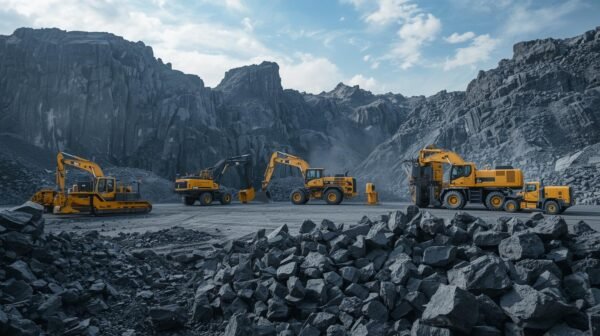
Basalt, one of the most abundant volcanic rocks on Earth, has become an indispensable material in construction, road building, and industrial applications.
Its exceptional hardness and durability make it ideal for producing high-quality aggregates, but these same properties present unique challenges when selecting quarrying equipment.
Understanding how to choose the right machinery can mean the difference between a profitable operation and costly downtime.
Understanding Basalt’s Unique Properties
Before diving into equipment selection, operators must recognize what makes basalt particularly demanding.
With a Mohs hardness rating between 5 and 6.5, basalt ranks among the toughest rocks to process.
Its abrasive nature accelerates wear on machinery components, while its crystalline structure requires substantial crushing force. These characteristics directly influence equipment choices and operational strategies.
Primary Crushing Equipment: The Foundation of Your Operation
The journey from raw basalt to usable aggregate begins with primary crushing. Jaw crushers have long dominated this stage due to their ability to handle extremely hard materials and accept large feed sizes up to 1,500mm.
Their simple toggle mechanism and robust construction make them reliable workhorses in basalt operations.
However, gyratory crushers present compelling advantages for high-capacity operations exceeding 1,000 tons per hour.
Also Read: Cone Crushers vs. Impact Crushers: Which Is Better for Basalt Aggregates?
While requiring higher initial investment, gyratory crushers offer continuous crushing action, reduced downtime, and lower operating costs per ton when processing large volumes of basalt.
Critical factors in primary crusher selection include feed size, desired output capacity, and the basalt’s specific compressive strength at your site. Sites with particularly hard basalt formations may benefit from crushers with higher crushing force ratings and reinforced wear components.
Secondary and Tertiary Crushing Solutions
After primary crushing, cone crushers emerge as the preferred choice for secondary and tertiary stages.
Their crushing chamber design, which uses compression between a mantle and concave, proves exceptionally effective with basalt. Modern cone crushers feature hydraulic adjustment systems allowing operators to fine-tune product size and optimize throughput.
Impact crushers, while popular for softer materials, generally prove less economical for basalt due to accelerated wear on blow bars and impact plates.
When used, they should be reserved for producing specific product shapes or handling pre-screened material with controlled feed sizes.
Vertical shaft impact (VSI) crushers deserve special consideration for final shaping stages. These machines excel at producing cubical particles essential for premium aggregate products and manufactured sand.
When processing basalt, VSI crushers should feature rock-on-rock crushing chambers to minimize wear and extend component life.
Screening and Classification Equipment
Efficient screening separates successful operations from struggling ones. Vibrating screens must withstand the abrasive punishment of basalt while maintaining classification accuracy.
Heavy-duty screens with replaceable polyurethane or wire mesh panels prove most durable, though operators should expect more frequent media replacement compared to operations processing softer materials.
Multi-deck screening systems maximize efficiency by producing multiple size fractions in a single pass. For basalt operations, screens with adjustable throw and frequency allow optimization for specific particle sizes and production requirements.
Conveyors and Material Handling Systems
Conveyor selection for basalt quarries demands particular attention to belt composition and support structure.
Steel cord reinforced belting provides superior tensile strength and impact resistance necessary for handling heavy, angular basalt aggregates. Impact beds at loading points and properly tensioned belts prevent premature failure and reduce maintenance costs.
Chute design throughout the processing plant significantly impacts equipment longevity. Properly engineered chutes with wear-resistant linings minimize material velocity and reduce impact forces, extending equipment life across the entire operation.
Wear Protection and Maintenance Considerations
Equipment longevity in basalt operations hinges on proactive wear management. Manganese steel remains the standard for crusher liners, though newer alloys incorporating chromium and molybdenum offer extended life in highly abrasive conditions.
Some operations report 30-50% longer liner life using premium alloy compositions despite higher upfront costs.
Establishing predictive maintenance programs using vibration analysis, thermal imaging, and regular wear measurements prevents catastrophic failures.
For basalt operations, documenting wear patterns helps optimize replacement schedules and identify opportunities for component improvements.
Auxiliary Equipment for Complete Operations
Beyond crushing and screening, successful basalt quarries require properly sized feeding equipment, dust suppression systems, and quality control instruments.
Apron feeders or heavy-duty grizzly feeders protect primary crushers from oversize material while regulating feed rates.
Comprehensive dust collection systems not only ensure regulatory compliance but also improve visibility, reduce equipment contamination, and create healthier working environments. Water spray systems at transfer points and enclosed conveyors minimize airborne particulates.
Making the Final Selection
Selecting basalt quarry equipment requires balancing immediate budget constraints against long-term operational costs.
While premium equipment commands higher initial investment, reduced downtime, lower maintenance expenses, and superior product quality typically justify the premium within 3-5 years of operation.
Engaging with equipment manufacturers early in the planning process provides access to application engineering expertise.
Reputable suppliers offer site-specific recommendations based on basalt characteristics, production targets, and local operating conditions, ensuring your equipment selection positions your operation for sustained profitability.

- Africa’s Water Reuse Opportunity: Building the Infrastructure for a Water-Secure Future - September 28, 2026
- Why Water Reuse Is Becoming a Business Imperative for African Industry - September 28, 2026
- Africa’s Water Reuse Opportunity: Why Treatment Plants Must Be Designed as Complete Systems - September 22, 2026