

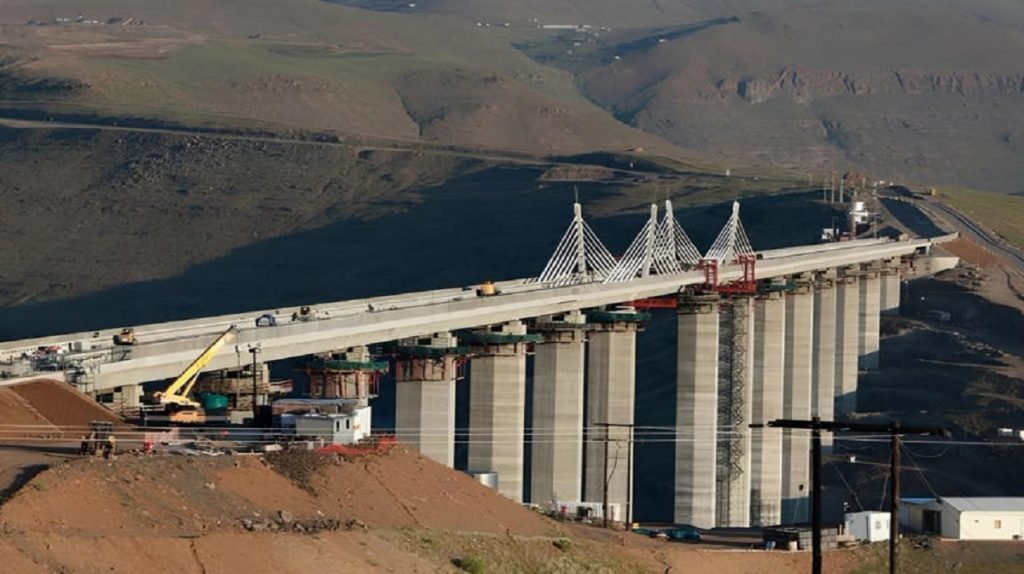
Mokhotlong, 22 April, 2026: A landmark infrastructure ceremony unfolded in the mountain kingdom of Lesotho on Wednesday, 22 April 2026, as South African President Cyril Ramaphosa, King Letsie III, and Prime Minister Samuel Matekane jointly launched the Senqu Bridge — a R2.4 billion engineering achievement that marks the most consequential milestone yet in the R53 billion Lesotho Highlands Water Project (LHWP) Phase II.
The launch, held in the remote Mokhotlong district, signals far more than the opening of a road crossing.
It is the final piece of advance infrastructure that physically makes way for the Polihali Reservoir to fill — meaning the dam itself, the 38-kilometre transfer tunnel, and ultimately the transfer of billions of cubic metres of Lesotho water to drought-stressed Gauteng can now proceed in earnest.
Africa’s First Extradosed Bridge of Its Kind
Standing 90 metres above the Senqu River and stretching 825 metres in length, the Senqu Bridge is not only the largest of three major crossings being built under LHWP Phase II — it is also the first extradosed bridge ever constructed in Lesotho.
The structure blends cable-stayed and prestressed girder design, and was built using an incremental launching method specifically chosen to reduce environmental disruption in one of Southern Africa’s most rugged and ecologically sensitive terrains.
Design was led by Zutari (formerly Aurecon Lesotho), with construction awarded in August 2022 to the WRES Senqu Bridge Joint Venture. The project generated approximately 250,000 person-days of employment, with a peak workforce of around 1,200 workers, the majority of them Basotho nationals.
The two companion crossings — the Mabunyane and Khubelu bridges — are progressing on schedule under the same Phase II programme and are designed to maintain road access for communities across the Polihali Reservoir once water levels rise following dam completion.
What This Launch Actually Unlocks
The Senqu Bridge had to come first. Its predecessor crossing sits directly in the path of the future Polihali Reservoir and will be submerged once the dam begins impoundment.
Without the new bridge in place and open to traffic, construction crews, supply chains, and the communities of Mokhotlong and Sani Pass would have been cut off. That constraint is now removed.
Simultaneously with the bridge launch, South Africa’s Minister of Water and Sanitation Pemmy Majodina and Lesotho’s Minister of Natural Resources Mohlomi Moleko unveiled a state-of-the-art Tunnel Boring Machine (TBM) — the equipment that will now begin drilling the 38-kilometre tunnel linking the Polihali and Katse reservoirs.
That tunnel is the physical conduit through which Lesotho’s highland water will eventually flow into South Africa’s Vaal Dam system, feeding the Gauteng conurbation of nearly 15 million people.
| LHWP PHASE II — WHAT COMES NEXT
Water transfer from Polihali to Katse Reservoir: targeted start 2028 | Oxbow Hydropower Scheme (80.3 MW) commissioning: 2029–2030 | Annual water supply increase: 780 million m³ → 1,270 million m³ | Lesotho hydro generation increase: 500 GWh → 800 GWh per year | Total Phase II project value: R53 billion |
Water Security Stakes for Gauteng
South Africa’s Gauteng province, home to Johannesburg, Pretoria, and the economic engine of sub-Saharan Africa, faces a structural water deficit that Phase II is specifically designed to address.
Once the Polihali Dam is complete and the transfer tunnel operational — currently targeted for 2028 — annual water supply capacity will increase from 780 million cubic metres to 1.27 billion cubic metres per annum, a 63 percent increase that planners say will secure the region’s supply for decades.
The project is governed by the 1986 Lesotho Highlands Water Treaty between South Africa and Lesotho, with Phase II formalised under a 2011 agreement.
Lesotho benefits not only from water royalties but from a significant boost to domestic electricity generation: the Polihali inflows will raise output at the Muela hydropower plant from 500 GWh to 800 GWh annually, meaningfully reducing the kingdom’s dependence on electricity imports.
An Engineering Milestone in Extreme Terrain
The Mokhotlong district sits at high altitude in one of the most topographically challenging areas of Southern Africa.
Building an 825-metre, 90-metre-high bridge here presented formidable logistical and geotechnical obstacles — from seasonal extreme weather and mountain access constraints to the need to protect the Senqu River’s sensitive river system below.
The incremental launching method used by the WRES JV was specifically selected to avoid the need for falsework in the river channel, a technique more commonly seen on major European and East Asian infrastructure projects.
The Polihali Dam itself, a concrete-faced rockfill structure approximately 165 metres high, will create a reservoir with a surface area of 5,053 hectares.
Main dam works contracts were awarded in November 2022, with construction beginning in early 2023. The bridge launch now clears the last logistical obstacle before the reservoir begins to fill.
Senqu Bridge — Key Specifications at a Glance
| Parameter | Detail |
| Structure | Senqu Bridge |
| Total Length | 825 metres |
| Height Above Ground | 90 metres |
| Construction Cost | R2.4 billion (~USD 146.7 million) |
| Bridge Type | Extradosed (first of its kind in Lesotho) |
| Construction Method | Incremental launching |
| Project Contractor | WRES Senqu Bridge Joint Venture |
| Design Lead | Zutari (formerly Aurecon Lesotho) |
| Employment Generated | ~250,000 person-days; peak workforce 1,200 |
| Launch Date | 22 April 2026, Mokhotlong, Lesotho |
| Parent Project | LHWP Phase II (total value: R53 billion) |
Regional Significance Beyond Water
The LHWP has long been held up as one of Africa’s most successful bilateral infrastructure partnerships.
Phase I, completed in 2003, established the Katse and Mohale dams and the Muela hydropower station, and has been delivering water to Gauteng for over two decades.
Phase II builds on that foundation but at a larger scale and with additional complexity — both in engineering terms and in the socio-economic resettlement and environmental management dimensions that accompany major highland reservoir projects.
For Lesotho, the project provides a critical and reliable revenue stream from water royalties, a significant employment dividend during construction, and an infrastructure legacy — roads, bridges, power lines, and housing — that will outlast the construction phase.
The feeder roads and additional pedestrian and vehicle bridges planned around the new reservoir will further open up connectivity in one of the kingdom’s most remote regions.
The launch of the Senqu Bridge on 22 April 2026 is, in this context, not merely a ribbon-cutting.
It is the green light for the hardest, most expensive, and most consequential phase of a project that will define the water security architecture of Southern Africa’s economic heartland for the next half-century.
Also Read
Mulilo pledges nearly R15bn for new renewable energy projects in South Africa
The $104 Billion Question: Why Africa’s Hotel Pipeline Keeps Missing Opening Deadlines

- How Municipal Water Treatment Works: Inside NYEWASCO’s Journey from Raw Water to the Tap - August 17, 2026
- LiuGong Brings a 27-Ton Electric Excavator to North America: Can the 924FE Challenge Diesel? - August 14, 2026
- Bank of Industry Headquarters: Inside Lagos’ 27-Storey Eko Atlantic Tower - August 14, 2026
