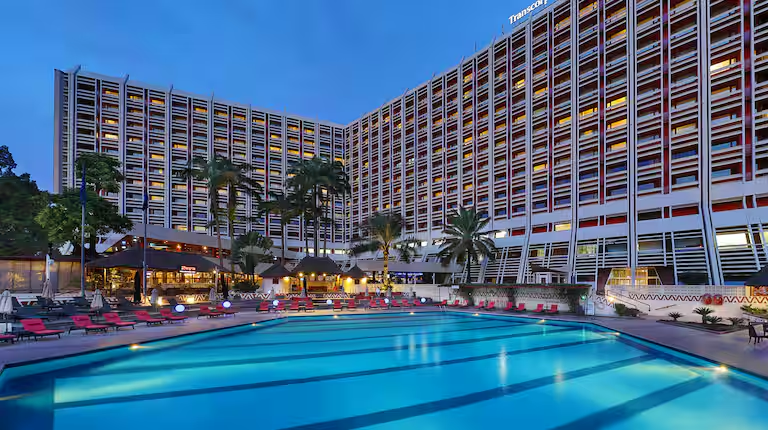
ABUJA — March 12, 2026 —Africa’s hotel development pipeline represents one of the largest concentrations of planned hospitality investment anywhere in the world.
According to the 2025 Hotel Chain Development Pipelines in Africa report by W Hospitality Group, there are currently 577 hotels and 104,444 rooms in active development across the continent — a 13.3% increase on 2024.
Yet the report is candid about a persistent problem: “for every project that opens on time, there are many more where groundbreaking announcements are followed by years of delay, abandoned construction shells, or quietly shelved plans.”
For every stakeholder in Africa’s construction and development ecosystem, understanding why is not optional — it is essential.
The Scale of the Delay Problem
The numbers lay bare the gap between ambition and delivery. In 2024, 59 hotels opened across Africa, representing approximately 9,559 new rooms. Against a total pipeline of 104,444 rooms, that is a conversion rate of roughly 9% of total pipeline in a single year.
The W Hospitality Group report puts the structural challenge in stark terms: “the average time from signing a hotel management or franchise agreement to opening the property is four to five years” — and in markets like Nigeria, where only 39% of the pipeline is currently on-site, many projects are running significantly behind even that extended benchmark.
Meanwhile, the pipeline keeps growing. In 2024 alone, 125 new management and franchise agreements were signed, adding 21,000 rooms to the development register.
The gap between announcement and delivery, the report concludes, “is not a temporary anomaly — it is a structural feature of African hotel development.”
Finance: The Primary Bottleneck
Ask any developer operating in African hotel markets what causes the most delays, and the answer is almost invariably the same: money.
Hotel development is capital-intensive, typically requiring debt financing for 50–70% of project costs.
In many African markets, the W Hospitality Group report identifies “the combination of high interest rates, limited appetite among local banks for long-tenure hotel loans, currency risk, and perceived political instability” as making debt financing both expensive and difficult to secure.
Foreign currency debt introduces a further structural complication. Hotel revenues are typically earned in local currency, while debt service obligations are denominated in US dollars or euros — a mismatch that, as the report notes, “becomes acutely painful during periods of currency depreciation — a recurring feature of many African markets.”
The rapid growth of franchise agreements is partly a direct response to this constraint. From under 10% of the total pipeline in 2020, franchise structures now account for 19% of Africa’s development pipeline in 2025.
The report explains why: “franchise structures typically require less equity from the operator and can be easier to finance through local debt markets.”
The trade-off, however, is significant — “franchised hotels require experienced owner-operators with the capability to manage a branded property without the intensive operational support that management agreements provide.”
Approvals, Land, and Regulatory Complexity
Finance is not the only culprit. The approvals environment is, according to the report, “a persistent source of delay.”
Planning permissions, environmental impact assessments, heritage assessments — particularly relevant in historic city centres like Marrakech and Cairo — and utility connection agreements “can each add months or years to the pre-construction phase.”
Land tenure uncertainty compounds the problem. The report warns that in several markets “title disputes emerge during construction, sometimes halting projects entirely,” and that “due diligence on land title before committing to a project is essential but not always conducted with sufficient rigour in the pursuit of deal momentum.”
Infrastructure readiness adds a further layer of risk. Reliable power supply, water access, and road connectivity “can also delay construction commencement and affect operational readiness even after construction is complete” — a risk the report identifies as particularly acute for “projects in secondary cities and resort destinations.”
Construction Capability and Supply Chain
Even where finance is secured and permits are obtained, execution risk remains real. The report identifies a shortage of experienced hotel construction contractors across several African markets, “particularly for the specialist fit-out work that upper-upscale and luxury properties require.”
Brand technical standards — covering MEP systems, finish quality, and structural tolerances — “exceed the experience base of many local contractors.”
The supply chain amplifies these pressures. Much of the specialist material required for internationally branded hotel construction — lifts, HVAC systems, specialist fixtures, and branded OS&E — is imported.
The report points to “port congestion, customs clearance delays, and logistics infrastructure limitations” as capable of adding weeks or months to delivery schedules, turning manageable programme slippages into serious overruns.
The 38% Actualisation Milestone — and What It Means
Against this challenging backdrop, the 2024 data offers a genuine reason for cautious optimism.
The actualisation rate — the proportion of projected hotel openings that actually materialised — reached 38% in 2024, up from 21% in 2023.
The W Hospitality Group report describes this as “the best performance since 2019,” noting that “markets where governments have invested in infrastructure, streamlined approvals, and encouraged foreign investment are seeing improved delivery rates.”
For contractors, the report’s guidance is direct: focus resources on markets with high on-site rates and proven delivery records.
Ethiopia (83.8% on-site), Morocco (72.4%), and Ghana (68.9%) represent stronger near-term pipelines than markets where the majority of announced projects remain in early development or financing phases.
What the Industry Must Do
The report is clear that closing Africa’s hotel delivery gap requires coordinated action rather than isolated effort.
Developers must conduct “more rigorous pre-development due diligence on finance, land, and approvals before signing management agreements and announcing projects.”
Operators must provide “more detailed and earlier technical guidance during design phases.” Governments must “accelerate approvals processes and invest in the infrastructure that makes hotel sites viable.”
And construction firms must “build local capability and supply chain networks that reduce reliance on imported labour and materials.”
The stakes could not be higher. With 155 hotels scheduled to open in 2025 and 149 in 2026, the W Hospitality Group report frames the challenge plainly: “the track record of the industry in meeting its own projections will determine whether Africa’s extraordinary hotel pipeline translates into the rooms, jobs, and tourism revenues the continent so urgently needs.”
The pipeline is vast. The demand is real. The question is whether the development ecosystem can finally close the gap between what is announced and what gets built.
Also Read
Why Ethiopia Has the Highest Hotel Construction Rate in Africa
R1.35 Billion Marriott Edition Hotel: Cape Town’s Ultra-Luxury Construction Milestone

- PV Guangzhou 2027 to Highlight Solar and Energy Storage Technologies - October 22, 2026
- Accurate and Reliable Measurement and Monitoring of Industrial Plant Water Treatment - October 21, 2026
- SODECA Highlights Industrial Ventilation Technology at Mega Clima Expo Kenya 2026 - October 14, 2026