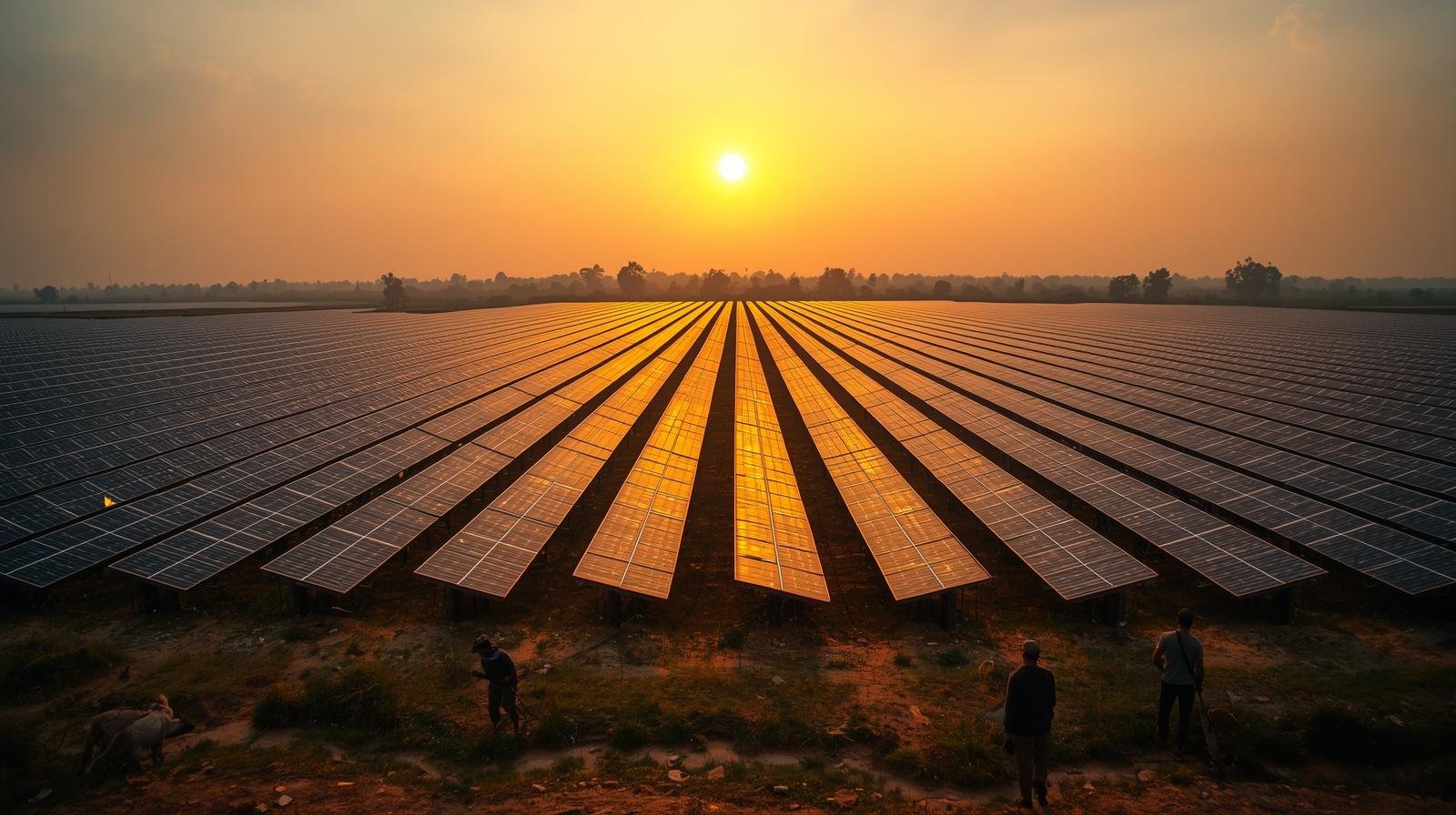
Washington, D.C. — February 25, 2026: In a landmark trade decision with far‑reaching implications for the global renewable energy market, the United States has announced preliminary duties of approximately 125–126% on solar cells and photovoltaic panels imported from India.
The sweeping action, aimed at protecting American manufacturers, could reshape supply chains and investment strategies across the solar industry.
The U.S. Department of Commerce said the duties are part of a broader effort to counter what it determined to be unfair government subsidies that have allowed Indian solar producers to sell equipment at prices that undercut domestic U.S. firms.
Similar measures were also applied to imports from Indonesia and Laos following investigations into export practices in those countries.
“After rigorous review, we found that certain foreign producers benefited from substantial government support that distorted market competition,” Commerce Secretary Gina Raimondo said in a statement.
“These preliminary duties are intended to level the playing field for U.S. solar manufacturers and encourage greater domestic investment.”
A Blow to Indian Solar Exports
The decision is expected to have a significant impact on India’s burgeoning solar industry, which has been rapidly expanding exports to the U.S. market in recent years.
Indian solar companies have played a growing role in global supply chains, offering a lower‑cost alternative to Chinese modules and benefiting from government incentives under India’s export promotion schemes.
Stocks of major Indian solar manufacturers fell sharply in early trading following the announcement, as investors reacted to the prospect of reduced access to the world’s largest solar market.
“U.S. duties of this magnitude — above 125% — create a high tariff barrier that effectively pricing out Indian panels from many U.S. projects,” said energy industry analyst Priya Mohan.
“Companies will now have to reassess their export strategies and focus on other regions or domestic opportunities.”
Supporters Cite Need to Protect Domestic Industry
The decision has been welcomed by U.S. solar manufacturing groups, which argue that foreign competition subsidized by governments distorts markets and threatens jobs at home.
“Without safeguards, U.S. solar manufacturers face an uneven playing field,” said Abigail Ross Hopper, president of the Solar Energy Industries Association.
“We support measures that encourage strong American production while driving innovation and competitiveness.”
The U.S. solar industry has been pushing for stronger domestic manufacturing capacity as part of broader climate and economic policy goals. Supporters of the tariffs argue that protecting and nurturing local production is essential for long‑term energy security and supply chain resilience.
Industry Concerns and Potential Fallout
However, energy developers and clean‑energy advocates have expressed concern that higher import costs could translate into more expensive solar projects at a time when the U.S. seeks rapid renewable deployment to meet climate targets.
“Tariffs may have the unintended consequence of slowing solar installations, especially in regions where domestic module supply is limited,” said Julian Martinez, a renewable energy consultant. “Policymakers will need to balance industry protection with broader climate and energy affordability goals.”
What’s Next: Anti‑Dumping Investigations and Final Rulings
The duties announced this week are still preliminary, and a final determination is expected by mid‑2026. A separate anti‑dumping investigation is also underway, which could result in additional tariffs based on pricing practices.
Indian exporters have signaled intentions to contest the findings, and industry groups in New Delhi are reviewing legal and diplomatic options.
Global Solar Supply Chain at a Crossroads
The U.S. action comes at a time of dynamic change in the solar manufacturing landscape. With efforts underway worldwide to diversify supply chains beyond China, India has positioned itself as a strategic alternative.
The new U.S. tariffs, however, complicate that trajectory and may accelerate shifts toward other markets, such as Europe, Southeast Asia, Africa, and Latin America.
For global developers and investors, the unfolding situation highlights the complex interplay between trade policy, renewable energy deployment, and international competition.
Also Read
Africa’s Solar Capacity Surges 54% as Financing Barriers Persist
Europe Steps In: Major Backing Secured for Egypt’s Obelisk Solar Mega Project

- How They Were Built: Inside the Engineering of the Lesotho Highlands Water Project - October 11, 2026
- Africa’s Water Reuse Opportunity: Building the Infrastructure for a Water-Secure Future - September 28, 2026
- Why Water Reuse Is Becoming a Business Imperative for African Industry - September 28, 2026